As the activities of the Garden of Maitreya increase and become more diverse, as it’s only normal… we find new friends, we establish collaborations with other groups of Buddhists within Romania, and we get to know ourselves better – in a good, wholesome and constructive way. Ever since I started my activity as a Buddhist, the quality of my acquaintances changed. I met people always willing to help, never willing to harm, and those are rare treasures in our lives. I cherish the good friends I have made along the way, and I hope we will continue to work together and share the Dharma and do our part in this world, together, in harmony.
One such precious friend is Marius Micu, an architect and coordinator of the White Mahakala Buddhist Study group from Cluj-Napoca, Romania. Marius, just like ourselves at Bucharest, is following the guidelines of FPMT, nourishing his activity with his personal skills and great devotion towards the Triple Gem. Marius is an architect, and therefore it’s no wonder he managed to build a true treasure in the heart of Romania.
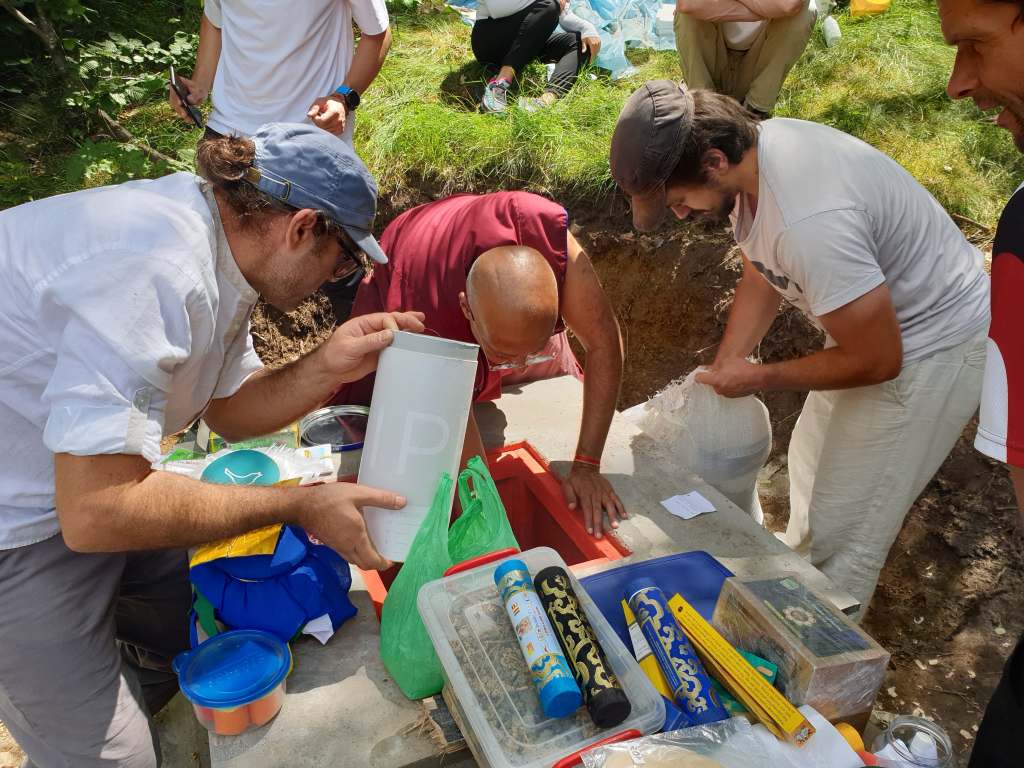
Not only that, but he has achieved a milestone in what concerns the development of the Buddhist works on the territory of Romania, by the fact that he has built a stupa – one of the first ones to exist in our country, through great and joyous personal effort. I have witnessed the various stages of the construction as Marius was generous enough to share photos, and to see this special monument shaped by loving hands – it was a precious gift, for which we are grateful to him, as well as to all the Masters who came to bless the work and the volunteers who came to help along.

However, what is a stupa? A stupa is a dome-shaped structure that serves as a Buddhist shrine, and it represents one of the most distinctive architectural forms in Buddhism, symbolizing the Buddha’s presence and serving as a place for meditation and pilgrimage. The design and elements of a stupa are rich with symbolic meaning, often representing the enlightened mind of the Buddha.
Traditionally, stupas contain relics (and ours is no exception!) such as ashes and bones of holy persons. They can also hold sacred texts or objects associated with the Buddha’s life and teachings. The stupa’s shape, typically consisting of a base, a dome, a spire, and a crowning element, each has symbolic significance, reflecting different aspects of Buddhist cosmology and teachings.
The base represents the earth, symbolizing the foundation of the practice. The dome signifies water, representing the process of purification. The spire, often consisting of multiple levels, symbolizes fire, reflecting the stages of enlightenment. The top of the spire, often a small parasol or pinnacle, represents the air or the attainment of nirvana. Marius has taken such care to each of those elements, making sure that the proportions are perfect, and the assembling of the components is done with utmost care. When the shared the photo in which the upper parts were put into place over the base (throne), I could not contain my tears of joy.


A stupa is so much more than a physical structure! Having a Buddhist stupa on the territory of a country holds paramount importance! The presence of a stupa elevates the spiritual atmosphere of a place, creating a sense of peace and sanctity that permeates the surrounding area.
Moreover, a stupa serves as a constant reminder of the Buddha’s teachings and the principles of Buddhism, such as compassion, mindfulness, and the pursuit of enlightenment. For practitioners, the stupa becomes a symbol of hope and inspiration (and I want to reassure Marius that it is absolutely true for all of us) encouraging us all to follow the path laid out by the Buddha. The act of circumambulating the stupa, which involves walking around it in a clockwise direction, is a practice that symbolizes the journey towards enlightenment and the accumulation of merit. May we all be graced with the chance of going there and walking around it, in love and peace and joy.
It is perhaps a good moment to point out that one of our common spiritual Masters – Geshe Sherab, a revered FPMT teacher that often visits our country, has given a very precious name to the retreat center currently being built in the proximity of the stupa – the Garden of Happiness and Joy.
The spiritual significance of a stupa extends beyond individual practice, influencing the broader community. It acts as a spiritual hub where people of all ages and backgrounds can gather, fostering a sense of unity and shared purpose. This communal aspect is particularly important in promoting social cohesion and harmony, as it brings people together in a shared space of reverence and devotion. We cannot travel there very often – especially us, the Bucharest team, but we do promise to go at least once a year and spend time with our friends and in the presence of the spiritual Masters that will be invited.

What else is happening at the White Mahakala Center in Cluj-Napoca? The center is a vibrant hub of Buddhist education and practice, offering a diverse range of courses and activities designed to deepen the Romanian people’s understanding and engagement with Buddhism. Many of the courses are conducted in English, being dedicated to both beginners and advanced students. For those new to Buddhism, the center provides introductory courses such as “Introduction to Buddhism” and “Buddhism in a Nutshell,” which lay the foundational concepts and practices of the tradition and following the guidelines of FPMT. Advanced students can further their studies through empowerments.
In addition to these regular courses, the center hosts various esteemed guests, primarily from Nalanda Monastery in France and the Lama Tzong Khapa Institute in Italy, bringing a wealth of knowledge and experience to the participants. One of the highlights of the center’s annual calendar is the spiritual retreat based on the “Discovering Buddhism” course. This year, the retreat spanned five days in June and was graced by the presence of the venerable Tenzin Gendun, offering participants an immersive and transformative experience. We are very grateful to him.
The center’s activities are not limited to traditional Buddhist teachings. It actively collaborates with psychotherapists to guide meditations aimed at achieving emotional balance, providing a holistic approach to mental and spiritual well-being. Facilitators for various meditation techniques are also available, ensuring that practitioners can find a method that resonates with them.
A series of associated programs further enrich the center’s offerings. Tibetan bowl concerts provide a unique auditory meditation experience, and mandala painting workshops allow participants to engage in a creative and meditative practice. These workshops include all necessary materials, and participants can create and take home their mandalas, symbolizing their spiritual journey.
The center also runs the “Silent Space” project, opening its doors for unguided meditation sessions where individuals can practice in a tranquil environment. These sessions conclude with group discussions, allowing participants to share and reflect on their meditative experiences.
To Marius and all the friends at White Mahakala: I am so happy that we met (even though, not yet in person!) and we are collaborating beautifully. Harmony is a rare thing in our well-tried country, where tolerance and acceptance still need to be cultivated at a larger level. The Buddhist community in our country is small, but active and beautiful, and one of our major goals is common to all religions: the understanding that all beings wish for happiness and do not wish to suffer, and the way in which we can work with this goal each day of our lives, to improve the lives of the others, and to make ourselves into better persons.
In order to reach the Stupa, you need to reach the village called Tranisu, in Cluj county, located at these coordinates: 46°51′55″N 22°48′48″E. Access to Stupa: from DN 1 go up Valea Drăganului 8.7 km, on DJ 764 B, until the intersection with DC 131, then turn left for another 1.5 km uphill, on DC 131.
For more precise information and the exact GPS coordinates of the Stupa, you can consult the White Mahalaka Center’s website and contact the coordinators directly.
The colleagues at White Mahakala are currently building a retreat center right near the stupa, for which they need construction materials. You can contribute to those precious efforts via the following accounts:
Accounts:
EURO Account
IBAN: RO10BTRLEURCRT0417728301
RON Account
IBAN: RO33BTRLRONCRT0417728302
USD Account
IBAN: RO14BTRLUSDCRT0417728301
Bank Details:
Name: Banca Transilvania
bank Address: Cluj-Napoca, Cluj, str. G. Bariţiu nr.8, 400027
SWIFTCODE: BTRLRO22
Account Name:
ASOCIATIA CENTRUL BUDIST WHITE MAHAKALA
The Garden of Maitreya accompanies this story with a little donation towards the construction of the retreat center; in the near future, should all our joint activities go well, we plan to contribute more consistently.
Photo credits: Andrei Odaciuc, Mircea Lupescu, Centrul Budist White Mahakala
Veronica Anghelescu
 The Garden of Maitreya