At the beginning of the month of September, I had the great joy and honor to be invited to attend the opening lecture for this new trimester of teachings unfolding at Lama Tzong Khapa Institute in Pomaia, Italy, within the Master’s program framework. I have been attending the Master’s program classes since early 2023 in the online environment, so receiving an invitation from my revered Teacher, Geshe Jampa Gelek, to be physically present in the teaching hall has been tremendous and wonderful, and enriching at all levels.
Life often puts lessons in front of us where we would not expect them to be put, and it was very much the case with this trip. Reaching Pomaia, from my country of residence (Romania) is not easy; flights are only available every two days (from Bucharest to Pisa) and from there onwards, a trip by train and by bus must be undertaken. Mind you, it can be a little challenging. I have been blessed with the ability to speak Italian, but even so, it took me a moment to get used to things around there.
I am most grateful for the day I spent in Pisa, due to my flight being late and the absence of good transport connections towards Pomaia; it was a logical thing to do, to stay overnight. I did well, for I had the opportunity to see one of the most beautiful, most astonishing, most incredible wonder of this world – the Leaning Tower of Pisa, which had been on my bucket-list since early childhood; I knew it was splendid, from stories and photographs; but to see it in reality – this overpasses any imagination. The Tower stands there, defying gravity, inclined by four degrees; you arrive in the Cathedral Square, you see it… and it just takes your breath away.

We can learn a Dharma lesson from everything that is around us, and seeing the Tower at the beginning of my trip to Pomaia has made me understand that there is beauty in what is not perfect (the tower’s inclination has been considered a fault for hundreds of years) and, perhaps, that things can be defined as perfect exactly because they have those so-called faults that make them unique. To be straight, firm and vertical might be splendid; it is what we usually expect a tower to be like – a beacon of stability. And to be inclined, as if doubting the consistency of the very reality around it, though logic-defying and astonishing – as one would not expect a tower to be – it is just as beautiful and just as splendid.
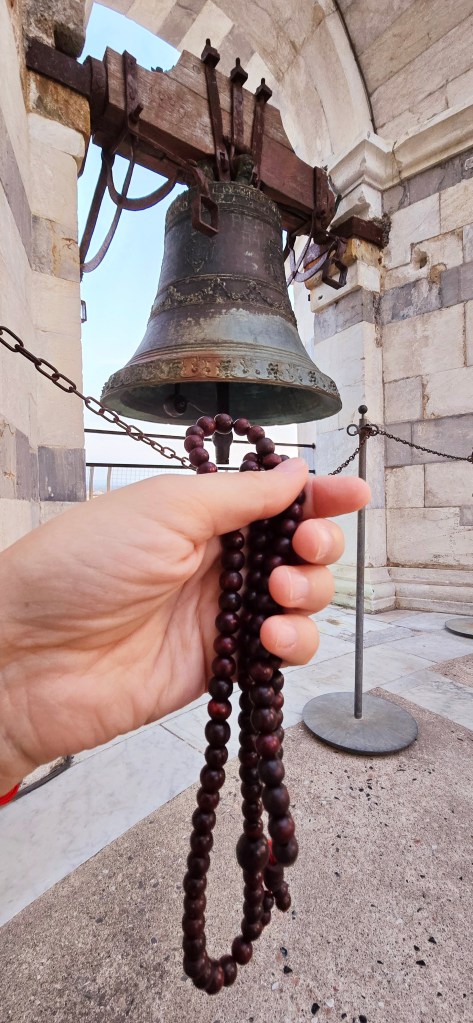
I gazed at it for hours; in the morning of my departure to Pomaia, I woke up very early and sat down on the Cathedral’s stairs, just contemplating the beautiful tower once more – an hour of grace and peace, which left me humbled and richer than I have been in years.
To reach Pomaia – and more specifically, Lama Tsongkhapa Institute is not easy. From Pisa Centrale Railway Station, you need to take a train to the town of Rosignano (a perfect little jewel by the Ligurian sea) and from there, either a bus (which comes rarely) or a taxi to Pomaia (a trip which lasts for about 20 minutes). I was lucky enough (and very grateful) for a friend to come pick me up from Rosignano and I reached Pomaia in the early morning of September 1, 2024.
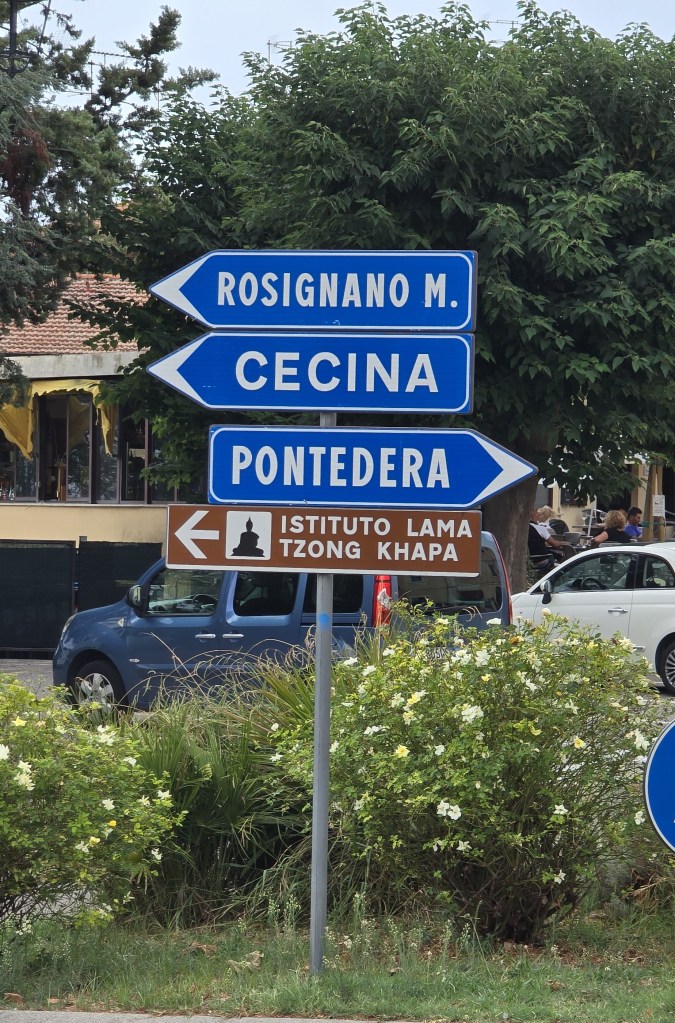
After paying homage to my noble Master, I went to visit the surrounding areas of Lama Tzong Khapa Institute which – I can assure you – they are just another piece of pure wonder. The buildings and stupas of the institute are built and decorated with perfect taste, and with respect for the surrounding nature. There are tall juniper and pine trees all around, making the whole area into a little forest, scattered with rocks and surprise-little stupas – and to my everlasting joy, with beautiful, well-fed cats. People who come by often build makeshift stupas by piling rocks one on top of another – their balance is sometimes precarious, so the people that come by afterwards, spend time to consolidate them. It would seem child’s play; but it is in fact, a very meaningful gesture through which each person makes a connection to the Dharma, an a purely intuitive way. May the Dharma knowledge of all beings that come to Pomaia increase and become higher and higher!
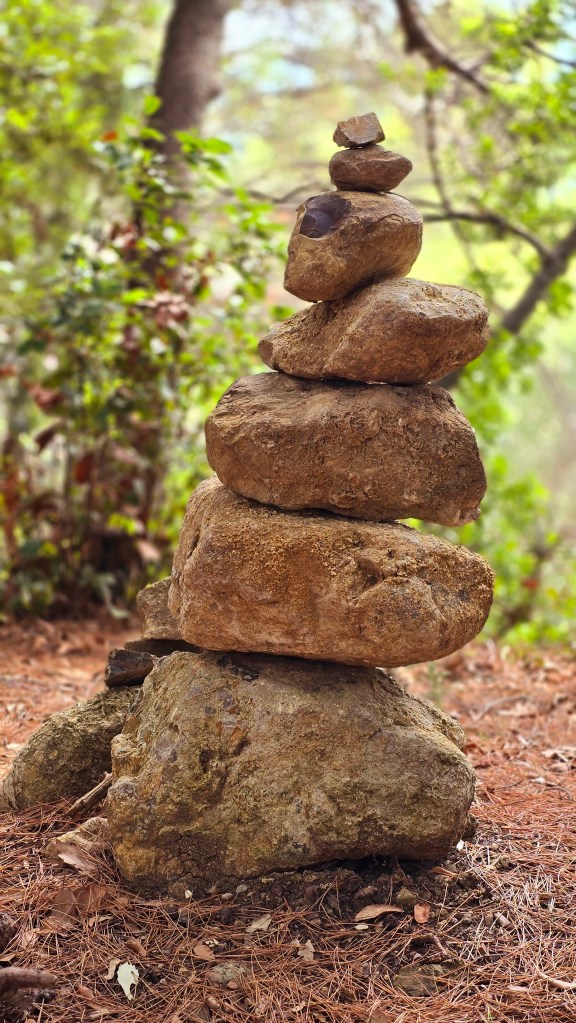
If you go to the Institute’s garden, you will also find a rock that smiles at you. You will smile at her; and I promise you, your soul will be warm, and you will want to never leave this blessed place. I made my own “tower” of rocks, and I vowed to repeat this exercise everywhere on my trips in nature, whenever I’d find rocks. It’s good for adults and for children; teach them to pile a few rocks up and to recite Om Mani Padme Hum, and you will have planted a very small Dharma seed in their mind – one that will flourish someday.

What exactly is the Lama Tzong Khapa Institute? The Lama Tzong Khapa Institute (ILTK) is situated in the serene village of which I have already told you about, Pomaia, Tuscany, approximately 40 km South of Pisa. The Institute is an esteemed branch of the Foundation for the Preservation of the Mahayana Tradition (FPMT), a global network of Gelugpa Dharma centers. The Institute is named in honor of Lama Tsongkhapa, the revered founder of the Gelugpa monastic tradition within Tibetan Buddhism. Over the years, it has been graced by teachings from His Holiness the Dalai Lama on several occasions.
Founded in 1977 by FPMT revered teachers – Lamas Thubten Yeshe and Thubten Zopa Rinpoche, the ILTK offers a wide range of courses on Tibetan Buddhism, primarily in Italian and English, with translations in additional European languages. Among these, the most distinguished is the Masters Program, a comprehensive six-year curriculum (formerly seven) dedicated to the in-depth training of future FPMT teachers, a program in which I am also enrolled.

A few words about my noble Master, Geshe Jampa Gelek – even though entire volumes would not be enough for me to properly speak of his kindness and wisdom.
Geshe Jampa Gelek was born in 1966 in Tibet. He graduated from Sera Je Monastic University in 1999, with the title of Geshe Lharampa. He is currently teaching Master’s program at Lama Tzong Khapa Institute, and he is one of the highly appreciated teachers within FPMT. He is visiting other centers in Italy (and not only) on a monthly basis, where he performs text analyses, he offers general teachings and empowerments. He has profound knowledge of Dharma, and he is renowned for the clarity of his teachings. He often performs sessions of questions and answers where the participants can ask any question, thus clarifying any difficult topic. He is lighthearted and always happy – following the tradition of all great teachers capable of chasing away any cloud with a single look. I have always felt immensely joyful to attend any of his teachings and grateful for every minute I was allowed to be in his presence: a rare gift.
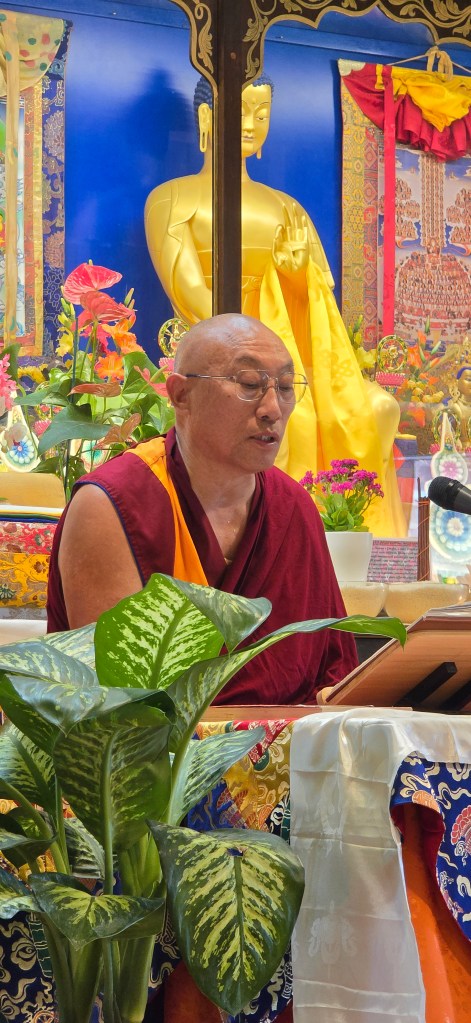
The purpose of my visit was essentially to meet all the friends at ILTK that I have met only online, and to attend the opening lecture of the Ornament for Clear Realization analysis – a part of the Master’s program currently unfolding at the Institute.
What exactly is the Ornament? Abhisamayalamkara, which translates into the Ornament for Clear Realization, is a fundamental Buddhist text of the Mahayana tradition, attributed to Maitreya and transmitted by the Indian Master Asanga, with commentaries elaborated by Haribhadra and Gyaltsab Dharma Rinchen, at their turn explained and elucidated by Geshe Jampa Gelek. If you think it is complicated, let me assure you… it is. The text provides a detailed study of Prajnaparamita, structed in eight categories and seventy topics. I have been studying it for over a year now, and my first contact with this text has caused me a sense of astonishment and even fear at not understanding anything. It was only after I had started doing transcripts of the oral lectures, after having spent countless hours on every page, that I began understanding it.
We, the students of the Ornament, understand very well that we probably need many lifetimes to completely and fully understand this text, but at least for now, we begin to acquire a general understanding, through the graceful help of our Teacher Geshe Gelek, his assistant Ven. Gyaltsen, the former assistant and translator of Ornament – Toh Sze Gee, and the interpreters currently performing translations in several languages (Filippo in Italian, Shahar in English). The study of the Ornament is a collective effort aimed at elevating our understanding and we are blessed.
I’ve had many moments of breakthrough while studying the Ornament, but those I cherish the most, useful to all readers, are those:
- Effort is needed when you wish to acquire an understanding. The higher, the nobler that understanding is, the greater your effort needs to be.
- As Asanga says, there is no supreme method to please the buddhas and bodhisattvas other than the proper practice of the three precious teachings: ethics, concentration and wisdom. Let us study them well and put them into practice each day of our lives.
- There are many ways to generate the mind of enlightenment into our own continuum, but among those, I use the last two in my meditations: not being able to bear the decline of the Mahayana teachings, and not being able to bear sentient beings tormented by suffering.
- Through generating the mind of enlightenment, we purify the causes of bad migrations created previously and we sever the continuity of accumulating further causes.
A few words about all the wonderful people I met during this wonderful trip:
I was so happy to meet Joan, the education coordinator! We had had a vast correspondence on the matter of transcripts, and I was glad to finally meet the person that has encouraged and cherished my work and inspired me to become better at it! It is thanks to his inspiring words that I did not give up.
Filippo! I rejoice in meeting Filippo face to face – I have learnt Italian grace to his crystal-clear translation, and I have spent countless hours transcribing from Italian.
Shahar! So glad to have met Shahar. His voice is forever engraved in my mind and soul, due to translating after his wonderful, clean, wholesome interpretation of our Master’s speech, from Tibetan into English.
Venerable Dechen – ah, beloved friend! To meet her in the middle of the street and share a hug and a chat, then to participate in class together with her! I have been friends with Dechen for a long time. I am overjoyed to have finally seen her – Venerable Dechen, who has also blessed my country with her presence and teachings.

Venerable Raffaello, another treasured and cherished friend, whom I had the privilege to meet on previous Dharma trips in which both of us accompanied our Master, Geshe Gelek. So glad to have seen a precious Dharma friend once more.
The Mother of Cats, Venerable Lhamo. I am absolutely certain that a person that takes care of animals is exceptionally good and pure. Only such people can devote hours of their day towards feeding and caring for those sweethearts – birds, cats, and anything else that comes around. Whenever I see such a person, I rejoice for I know I have met a true bodhisattva. Countless beings have made a connection with the Dharma, through her kindness. May she always be blessed! The sight of her feeding the doves and the cats will forever remain engraved in my heart. As it is said in the Dhammapada (verse 270): “One is not called noble who harms living beings. By not harming living beings one is called noble”.


Last, but not least – I want to mention the grace, helpfulness and generosity of my friend, Sherab Lotsawa. He is one of the researchers and translators of the Institute, often accompanying Geshe Gelek, Geshe Tenphel and other guests in the Dharma travels. As Geshe Gelek once characterized him, “Sherab has a very vast intelligence” and to that opinion I subscribe wholeheartedly. His name translates as “Wisdom” (Tib. Sherab = wisdom) and he is wise beyond words. I have lost count of the number of languages he can actually speak, and I am forever praising his research and linguistic skills. Each conversation with him has been an occasion for me to learn something new – and for this, I am grateful.

I wish I could have met Dir. Valerio, but he was away at the time of my visit. Perhaps next time.
Volumes of poetry could be written about the forests and stones around the Institute. With a sacred, secret life of their own, the tall trees and the splendid rocks, neatly arranged to form castles and circles and other odd and splendid shapes, they stop you in your tracks and cause you to gaze in wonder at how beautiful nature truly is. Go see those gardens and sit in silence, simply being, leaving all worries aside: it is what I have done, in solitude – and it has been a Dharma lesson in itself.
I have received from my Master’s blessed hands a book to carry back home to study: Madhyamakāvatāra by Chandrakirti that we will study next year in the Master’s program. I see this as a treasured prize, one that I hold most dear, and that I carried with great care from Pomaia to Bucharest, holding it tightly against my heart. My backpack was already heavy, so I made use of the clause that states that any passenger may bring reading material in the airplane; well, if my reading material weighed a good 3 kg, who could argue? And so, I am looking forward to study this utterly heavy book and to learn how all things are empty of any eternal self or soul.
It was a meaningful trip back home – a time for myself, for recollection of thoughts and meditation. To be high above the clouds in the airplane is a good experience for a Buddhist – it gives us a glimpse into what calm abiding should be like, and how up there, high above the all-obscuring clouds, there is no turbulence – just the clear sky. May our mind become just as clear, just as calm, and may we face all life’s trips bearing the Dharma in mind, the blessing of our precious guru in the heart, and warm benevolence towards all beings.

I want to conclude this article with a piece of advice about Refuge, taken directly from the Ornament (Chapter 1: Exalted Knower of All Aspects; topic 2/70 – Mahayana Instruction).
“Contemplate well upon the drawbacks of samsara in general, and the drawbacks of bad migrations in particular.
Then, in dependence on the two causes – (1) recollecting the fear of the drawbacks of samsara in general, and of bad migrations in particular and (2) knowing that the Three Jewels have the ability to protect from fear, tame your mind by going for Refuge in such a way that you entrust yourself to the Three Jewels from the bottom of your heart and then train properly in the trainings of Refuge.” (Asanga, Compendium of Ascertainments).
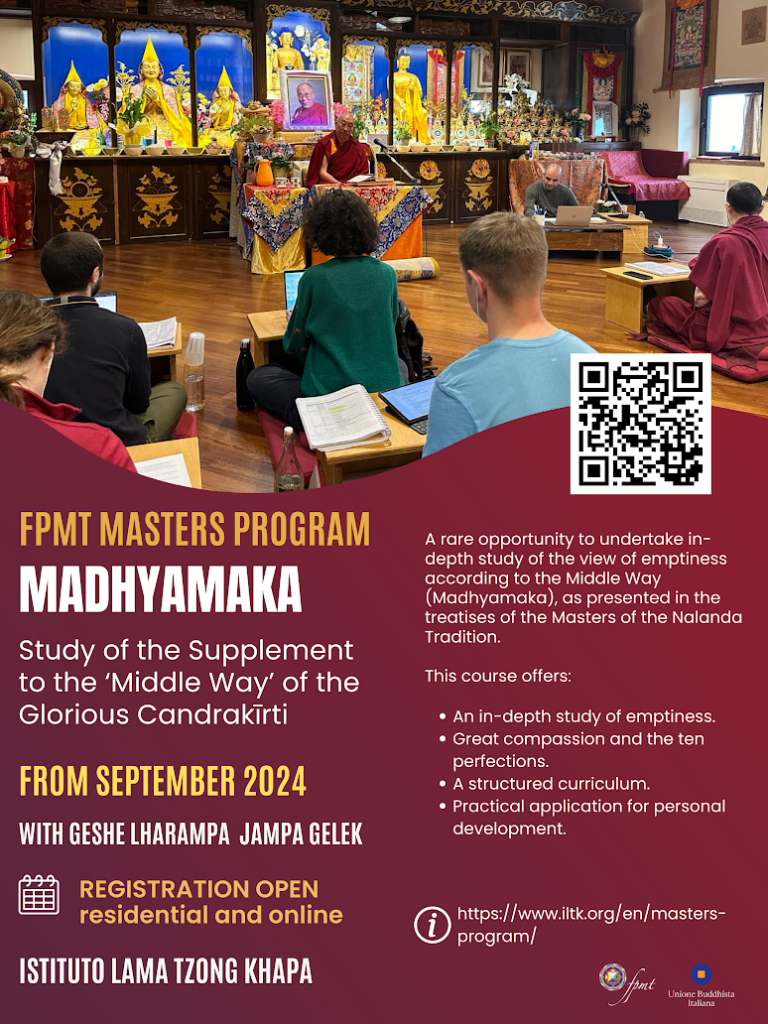
If you are interested in joining the Master’s program and study the Madhyamaka next year, please consult the ILTK Website.
With gratitude,
Dr. Veronica Anghelescu
 The Garden of Maitreya