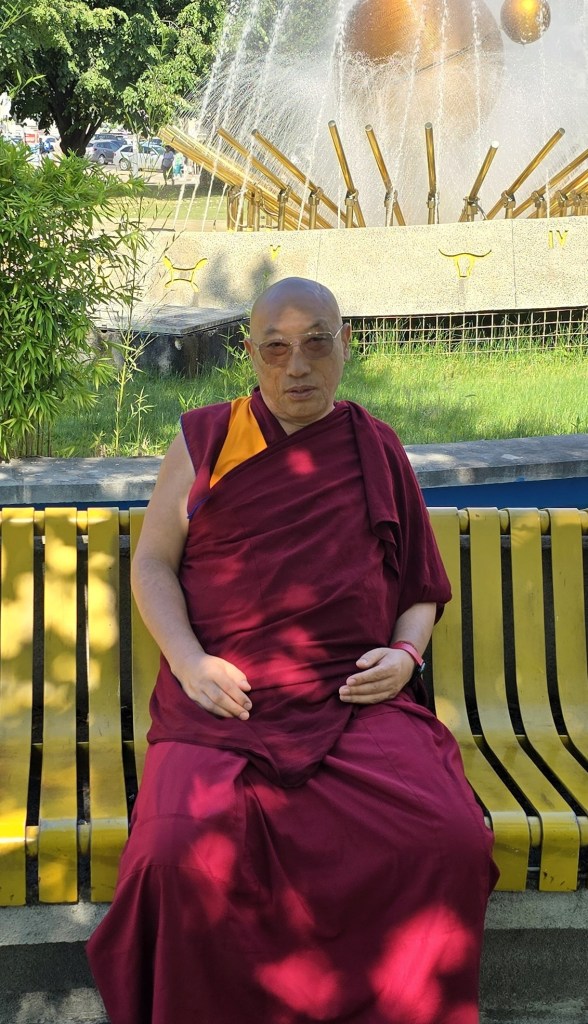
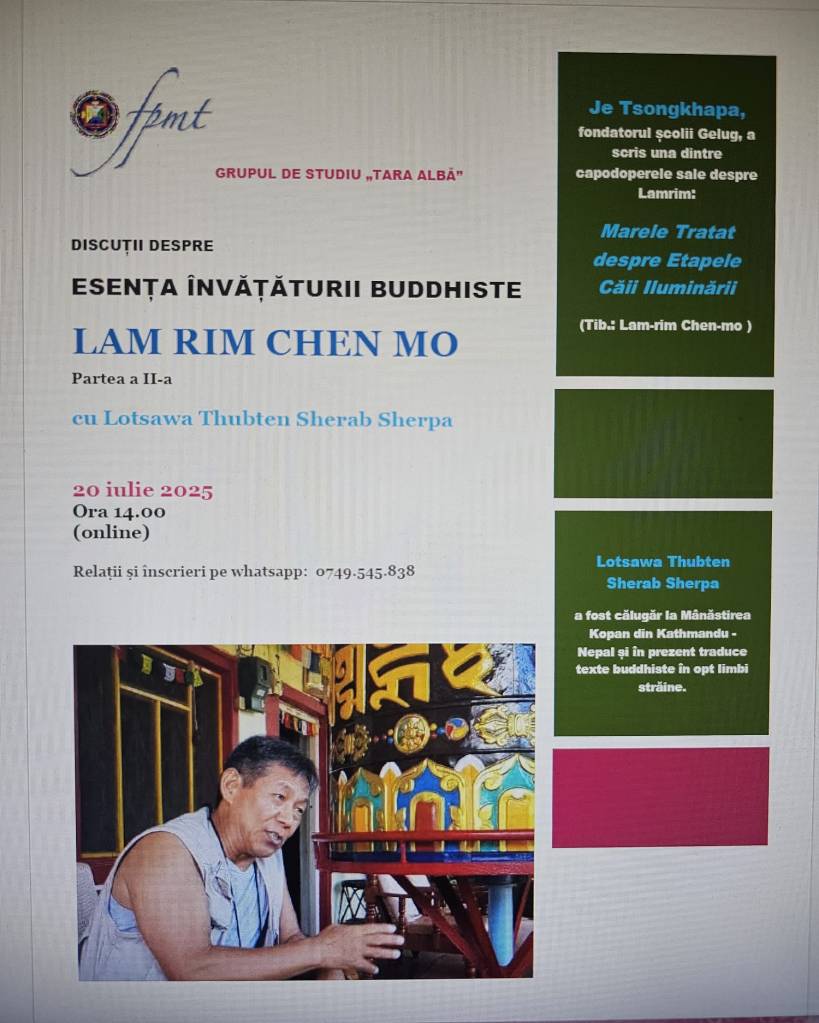
Prof. Lotsawa Sherab Sherpa
Reflections on Lam Rim Chen Mo
Transcript and Edit:
Veronica Anghelescu Drolkar
Garden of Maitreya – Bucharest
ISSN 3044 – 8972 ISSN L 3044 – 8972
I go for Refuge until Enlightenment
To the Buddha, the Dharma and the Sangha.
Through the merit of practicing generosity and the other accumulations,
May I attain Buddhahood for the sake of all beings.
Opening Reflections
Good morning and good afternoon to everyone. I am speaking to you from Italy, and the purpose of our meeting is to support one another by reflecting together on the Dharma.
As I mentioned, in our last session I may have created some confusion, which is only natural, since all of us living in samsara are prone to confusion. I hope it was not too unsettling for you. Today, I will try to clarify the points that may have been left unclear last time.
As you know, the essential reason we gather is to ensure that our lives become meaningful, today, tomorrow, and in the months to come. We study and practice the Dharma in order to cultivate happiness and reduce stress, not to increase it. I especially encourage you to maintain a relaxed mind, free from tension. In this way, our thoughts change, and we transform ourselves for the better.
So, traditionally, the great lamas and Geshes spend a long time simply setting the right motivation. For example, Lama Zopa Rinpoche, whom I deeply admire, could spend nearly an hour speaking only about motivation. His dedication made a profound impression on me. Such teachings are not merely conveyed through words but also through gestures, presence, and behavior. Often, simply seeing or hearing a lama briefly is enough to recognize the depth of their practice.
Now, when I think of this, I especially remember Lama Yeshe and Lama Zopa. Lama Yeshe, although not formally a Geshe, benefited countless people through his wisdom and compassion. The flourishing of Dharma centres and institutes today is inseparable from the prayers and aspirations of these great masters. Without their dedication, we would not be enjoying the Dharma as we do now.
Let us recall, the power of prayer and good wishes is immense. While it may seem that individuals achieve everything through their own effort, in truth conditions must come together. The prayers of realized masters create the conditions that allow our efforts to bear fruit. This is why I value prayer so highly: it is a way of serving and benefiting others at the deepest level.
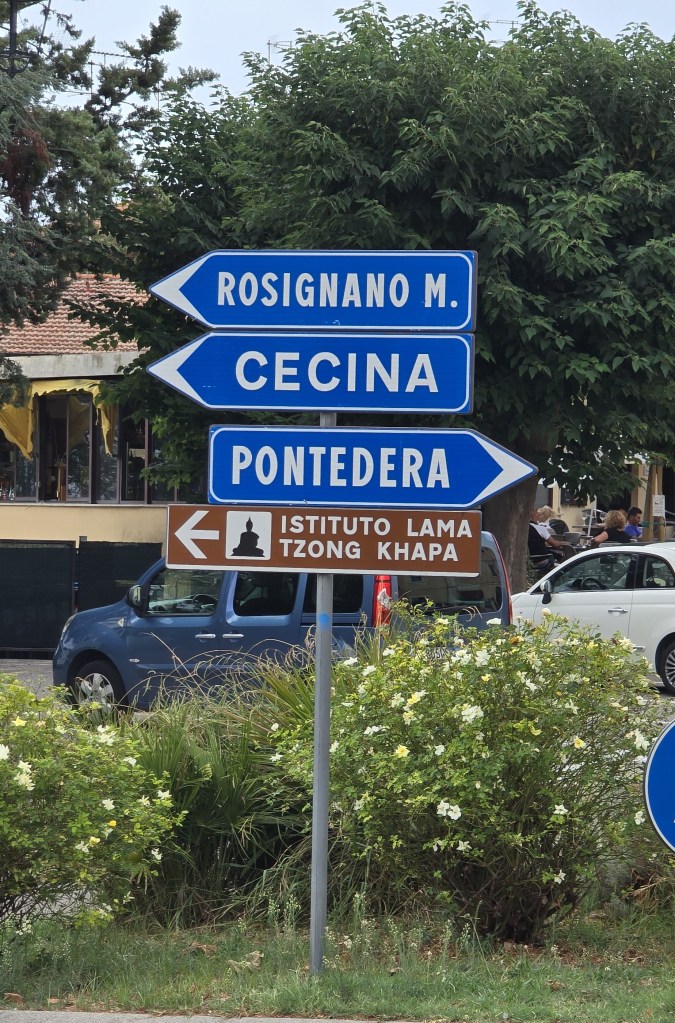
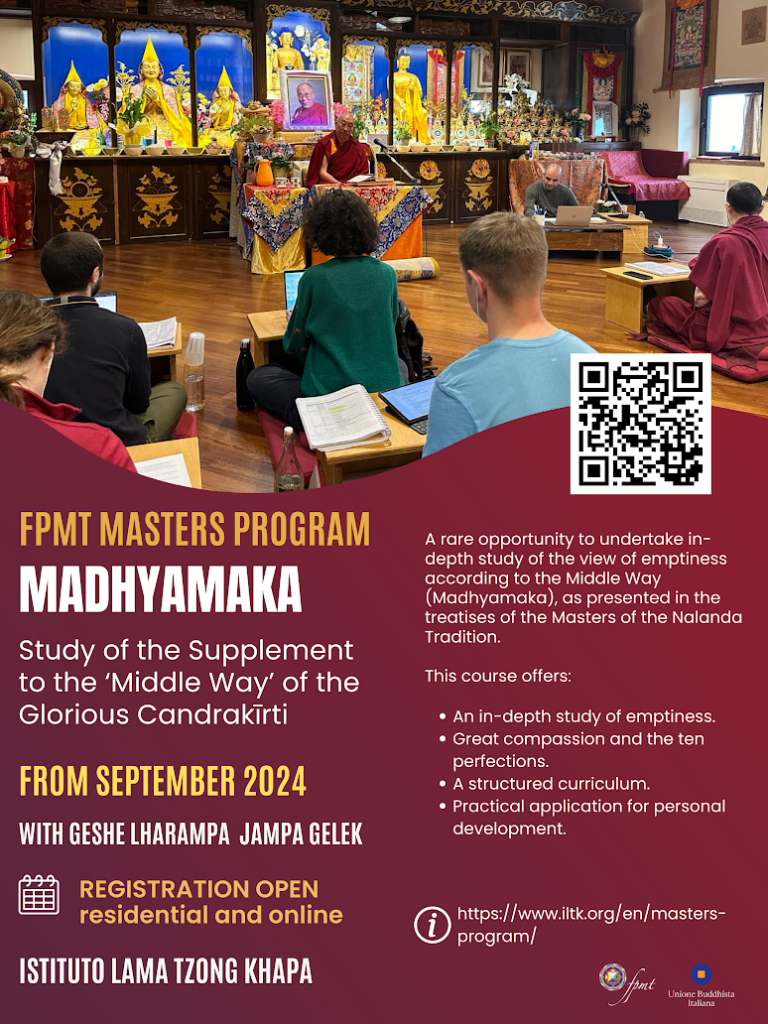
When I reflect on the origins of the Institute of Lama Tsongkhapa, I am struck by the way in which conditions come together through heartfelt connection. One story illustrates this beautifully. Many of you know Massimo Corona, who is still living today. His father once attended a teaching by Lama Yeshe in Milan. After listening, he was so deeply moved that he asked Lama Yeshe what he could do to help. Lama Yeshe replied that there was a need for a place to establish a Dharma center. Out of gratitude and faith, Massimo’s father offered land for this purpose.
As it is said, at first, Massimo’s mother was hesitant. She worried that such generosity would be misunderstood as the lama merely seeking financial gain. Yet, after meeting Lama Yeshe and Lama Zopa herself, she also felt their sincerity and transformed her perspective. In the end, she supported her husband’s decision wholeheartedly.
Indeed, this offering, made in the mid-1970s, became the foundation for the Institute of Lama Tsongkhapa. It arose not from planning or strategy, but from the power of heartfelt communication. When words and presence touch the heart, people are willing to dedicate themselves entirely.
Again and again, this story reminds us of the importance of motivation. If someone has a genuine motivation, everything becomes possible. Isn’t it? Our focus in these sessions is the Lam Rim Chen Mo, the Great Treatise on the Stages of the Path to Enlightenment. It is one of the most profound and comprehensive teachings, encompassing both Sutra and Tantra. Last time, when I attempted to explain the framework of the Buddhist teachings, I may have presented some points in a confusing order. Today, I wish to clarify them carefully.
I have prepared a list of the Twelve Deeds of the Buddha, which outline the essential events of his life. Although I know them by heart in Tibetan, it is more difficult for me to express them accurately in English. Therefore, I have written them down in advance so that I may present them clearly.
Surely, before appearing in this world, the Bodhisattva resided in Tushita heaven, the realm of joyful contentment. Seeing that the time had ripened for him to manifest as a teacher, he made the decision to descend into the human realm. Out of great compassion, he chose to be born where his presence would benefit beings most effectively.
You might recall, the Bodhisattva took birth in the royal family of King Śuddhodana and Queen Māyādevī. In a dream, Queen Māyā saw a radiant white elephant descending from the heavens and entering her right side, signifying the noble being who would be born. This moment marked the union of celestial intention and earthly manifestation.
The Twelve Deeds of the Buddha
In Lumbini Grove, beneath blossoming trees, Queen Māyā gave birth while standing and holding the branch of a tree. The child immediately took seven steps, and with each step a lotus appeared beneath his feet. He declared: “I am supreme in this world, and this is my final birth.” This wondrous event foretold the greatness of his future life.
As I mentioned, as a young prince, Siddhartha mastered all the royal arts and sciences. Whether in learning, skill in arms, or intellectual debate, he excelled with ease. Yet, though surrounded by comfort and honor, he remained inwardly unsatisfied, sensing that worldly accomplishments could not resolve the deeper questions of existence.
His family sought to protect him from suffering by surrounding him with beauty and pleasure. Three palaces were built for him, one for each season, filled with music, gardens, and attendants. Yet even in this environment of abundance, Siddhartha’s mind turned toward contemplation. He recognized that pleasure was fleeting, unable to shield him from aging, sickness, and death.
So, one day, while leaving the palace grounds, Prince Siddhartha encountered four sights: an old man, a sick man, a corpse, and finally, a wandering ascetic. These encounters pierced the illusion of worldly permanence. He realized that no power or wealth could prevent suffering, and that only the path of spiritual practice could lead to liberation. Moved by this insight, he resolved to abandon the palace life. Quietly, in the stillness of night, he left behind his wife, his infant son, and all the trappings of royalty. Mounting his horse, he departed the palace to begin his search for truth, a gesture of ultimate renunciation.
Now, for six years Siddhartha practiced severe asceticism, training with renowned teachers and subjecting his body to hardship. He meditated for long periods, fasted until he became emaciated, and endured extremes of deprivation. His discipline and determination were unmatched, but eventually he understood that self-mortification was not the path to awakening. A body weakened by suffering could not serve as a clear vessel for insight.
Let us recall, recognizing the futility of extremes, he chose the Middle Way, avoiding both indulgence and excessive austerity. Accepting a simple meal of milk-rice offered by Sujata, he regained his strength. Then, seated beneath the Bodhi tree at Bodhgaya, he vowed not to rise until he attained complete awakening. Mara, the embodiment of delusion, appeared with armies of fear and desire to disturb him. Yet Siddhartha remained unmoved, touching the earth as witness to his resolve.
Trough deep meditation, he realized the true nature of reality: dependent origination and emptiness. He transcended all obscurations and attained perfect Buddhahood. In that moment, Siddhartha became the Awakened One, the Buddha, endowed with boundless compassion and wisdom. The victory over ignorance was complete; the light of his realization began to illuminate the world.
At first, the Buddha hesitated to teach, reflecting that the truth he had realized was profound and difficult to grasp. Yet, moved by compassion for beings, he resolved to share it. Traveling to Sarnath, he gave his first sermon to the five ascetics who had once been his companions. There he expounded the Four Noble Truths and set in motion the Wheel of Dharma. This teaching opened the path for countless beings to begin their own journey toward liberation.
As it is said, throughout his teaching life, the Buddha displayed miraculous powers, not as a display of pride, but as a skillful means to inspire faith and open minds to the Dharma. He subdued those who were arrogant, healed the sick, and manifested countless forms in accordance with the needs of disciples. These miracles demonstrated not only his mastery over appearances, but also his deep compassion for beings whose hearts required tangible signs in order to turn toward truth.
Indeed, at the age of eighty, in the town of Kushinagar, the Buddha knew that his time in the world was drawing to an end. Lying between two trees, he gave final teachings of encouragement, urging his disciples to rely on the Dharma and on their own diligent effort. As the trees bloomed unseasonably, showering flowers upon him, he entered meditation and passed peacefully into parinirvana. His body was cremated, and relics were distributed across the land, becoming objects of veneration for generations to come.
Again and again, the Buddha’s passing was not an end, but the completion of a life lived entirely for the benefit of others. Through the Twelve Deeds, he provided a perfect model, from renunciation to awakening, from compassionate teaching to the final dissolution of form. His life remains an unbroken source of inspiration for all who seek liberation.
Having recalled the life of the Buddha through the Twelve Deeds, we now turn to the path he revealed. The Lam Rim, or Stages of the Path to Enlightenment, presents this journey in a clear and gradual sequence, guiding us from the very beginning of spiritual practice to its highest realization. It is a map of the Dharma, designed for ordinary beings like ourselves.
The Three Scopes of the Lam Rim
Let us keep in mind, in this system, all of the Buddha’s vast teachings are organized into three levels of motivation. The first level concerns those who wish to secure a favourable rebirth and avoid the lower realms. The second level is for those who seek complete liberation from the cycle of existence, samsara. The third level is for those who, moved by great compassion, aspire to attain enlightenment for the sake of all beings.
Surely, these three levels correspond to the three scopes: the initial, the intermediate, and the great. Together, they form a comprehensive training that encompasses the entirety of the Buddhist path.
You might recall, just as a large building requires a stable foundation, so too does the spiritual path. If we rush into advanced practices without grounding ourselves in the initial and intermediate stages, our understanding remains fragile. By beginning with the contemplation of precious human life, impermanence, and the reality of karma, we establish the firm base upon which higher realizations can be built. This is why the Lam Rim is so precious: it teaches us not only what to practice, but how and when to practice it. Each step is carefully placed, ensuring that the mind develops in a stable and harmonious way.
Reliance on the Teacher
As I mentioned, the Buddha taught both Sutra and Tantra, each with its own methods and emphasis. Sutra provides the essential foundation, the understanding of impermanence, suffering, and emptiness. Tantra builds upon this, offering swifter means through profound meditative techniques. Without Sutra, Tantra becomes unstable; without Tantra, Sutra remains slow. Practiced together, they form a complete path.
As you know, thus, the Lam Rim includes both. It begins with reflections accessible to anyone and culminates in the profound view and meditation that lead directly to enlightenment. So, for this reason, the setting of our motivation becomes crucial. Without proper motivation, even virtuous actions may lack true depth. The great lamas, such as Lama Zopa Rinpoche, would devote a great deal of time simply to establishing the right motivation before beginning any teaching or practice. This was not mere formality, but a profound reminder that our actions acquire their true meaning from the intention that underlies them.
Now, in the Lam Rim, the very first subject presented is reliance on the spiritual teacher. It is by relying upon a qualified guide that we can traverse the path with confidence. Without guidance, it is easy to lose direction, for our own wisdom is limited and clouded by habitual confusion. The teacher, embodying the lineage of realized masters, serves as a bridge between our present state and the awakening we seek.
To rely properly means more than merely receiving teachings; it means cultivating deep trust and respect. We recognize the teacher as a source of wisdom, compassion, and blessing, and we allow this recognition to transform our own mind. It is said that the blessings of the Buddhas flow through the teacher, like sunlight channelled through a magnifying glass, igniting the flame of realization within the student.
This reliance is not blind devotion. It is founded on examination. We must carefully consider whether a teacher possesses the qualities described in the scriptures: discipline, knowledge, compassion, and the ability to guide others. Once we have examined well and chosen a teacher, we place our confidence in them, committing ourselves to follow their instructions sincerely.
When we approach the teacher with humility and respect, our own receptivity increases. Even a few words spoken casually can strike deeply in the heart and open the door to transformation. This is why the Lam Rim begins with guru devotion: it is the fertile soil from which every realization grows.
As it is said, the relationship with the teacher is not like an ordinary friendship or a casual connection. It is a bond rooted in spiritual purpose. To rely upon a teacher means to cultivate gratitude and trust, even when their instructions challenge our habitual ways of thinking. A genuine teacher does not seek personal gain; their sole intention is to guide us toward liberation. When we hold this understanding in our heart, every encounter with them becomes a moment of blessing.
Indeed, the scriptures speak of two aspects of reliance: reliance through thought and reliance through action. Reliance through thought means viewing the teacher as inseparable from the Buddha, seeing their qualities with appreciation rather than dwelling on their human imperfections. Reliance through action means serving them respectfully, following their instructions, and embodying their teachings in daily life. When these two aspects are present, the connection with the teacher becomes a powerful source of transformation.
Again and again, it is important to remember that devotion is not about idealizing the personality of the teacher. Rather, it is about recognizing the function of the teacher as the living representation of the Dharma. Even a simple gesture, a glance, or a single phrase can awaken us when our mind is open. For this reason, devotion is often said to be the swiftest path to realization.
The benefits of reliance on a spiritual teacher are vast. Through devotion, we draw close to the blessings of the Buddhas and quickly accumulate merit. Obstacles that would otherwise block our practice begin to dissolve. Our mind becomes pliant, joyful, and receptive. Without such reliance, even diligent study and meditation may remain dry, lacking the warmth of inspiration.
Let us keep in mind, conversely, to abandon respect for the teacher or to give way to doubt and criticism closes the door to progress. Just as a seed cannot grow without fertile soil, spiritual realizations cannot flourish in a mind that lacks devotion. Therefore, cultivating reliance on the spiritual teacher is not optional; it is indispensable. It is the gateway to all other stages of the path.
Surely, once we have established reliance on the teacher, we are prepared to reflect on the rarity and preciousness of human life. This contemplation shifts our perspective from ordinary concerns to spiritual priorities. It awakens in us a sense of urgency, reminding us that life is brief and filled with opportunities that must not be wasted.
Our human life is endowed with freedoms and opportunities: freedom from the most obstructive states of existence, and the opportunity to practice the Dharma with access to teachers, teachings, and supportive conditions. Such a combination is exceedingly rare, like a jewel found in the vast ocean. To recognize its value is to feel immense gratitude and responsibility.
Impermanence, Karma, and Suffering
When we understand the rarity of this opportunity, we cannot help but feel inspired to use it wisely. If we waste this life on distractions or harmful actions, we will deeply regret it later. But if we dedicate ourselves to study, reflection, and meditation, then even ordinary days become meaningful.
As I mentioned, this recognition naturally leads to the contemplation of impermanence. Everything we see and experience is subject to change. Youth fades into old age, health into sickness, life into death. Nothing in samsara remains stable. Reflecting on this is not meant to make us fearful, but to awaken clarity. It reminds us not to postpone practice, for death can come at any time.
As you know, many people live as if they were immortal, endlessly making plans for tomorrow, next year, or the distant future. Yet none of us knows how long we will remain in this body. By remembering impermanence, our priorities become sharper. We recognize what truly matters, and we let go of endless attachment to trivial concerns.
So, in the Lam Rim, meditating on impermanence is not considered pessimistic; it is considered realistic. By facing the truth directly, we develop courage. When we acknowledge that our time is short, we stop wasting it. We devote ourselves wholeheartedly to the path, valuing every breath, every moment, as a chance to move closer to liberation.
Now, when impermanence is seen clearly, the next reflection arises naturally: the certainty of karma. Every action leaves an imprint, like seeds planted in fertile soil. Actions of body, speech, and mind shape our future experiences. If we act with kindness, honesty, and generosity, happiness follows. If we act with anger, greed, or deceit, suffering follows. No one else creates our destiny; we create it ourselves through our choices.
The Buddha explained karma with great precision. Small actions, repeated over time, accumulate into powerful results. Even the smallest gesture of kindness can bear vast fruit if supported by the right conditions. Likewise, a moment of anger or cruelty can lead to suffering if left unchecked. Understanding this, we become more attentive to how we live.
We can say, karma is not a system of punishment or reward, but a natural law. Just as fire burns when touched, negative actions bring suffering. Just as water quenches thirst, positive actions bring happiness. By aligning our behaviour with this truth, we can gradually transform our experience of the world.
When we reflect on karma, we see how important it is to avoid negative actions. The ten non-virtuous deeds, killing, stealing, sexual misconduct, lying, divisive speech, harsh words, idle gossip, covetousness, ill will, and wrong views, are the main causes of suffering. By restraining ourselves from these, we prevent future pain and create the space for virtue to grow.
As it is said, cultivating the ten virtues, respect for life, generosity, pure conduct, truthful speech, harmonious words, gentle communication, meaningful conversation, contentment, goodwill, and right understanding, plants the seeds of happiness. The more we practice them, the more peace we experience in our present life, and the more we secure happiness in future lives.
Indeed, by combining reflection on impermanence with an understanding of karma, we see the urgency of living meaningfully. Every day, every hour, offers us a chance to accumulate merit and purify negative tendencies. If we neglect this, we risk wasting the very conditions that make spiritual growth possible.
Lam Rim texts remind us that death is certain, but the time of death is uncertain. At the moment of death, nothing can accompany us, not wealth, not status, not possessions. Only the imprints of our actions follow us into the next life. This truth compels us to practice with sincerity and steadiness.
Isn’t it? when we take these reflections to heart, we begin to live differently. Gratitude for our human life deepens. Awareness of impermanence sharpens our focus. Understanding karma makes us more responsible. In this way, contemplation does not remain an intellectual exercise; it reshapes our daily conduct.
Let us keep in mind, another crucial reflection is the nature of suffering itself. The Buddha taught the Four Noble Truths, beginning with the truth of suffering. To recognize suffering does not mean to wallow in despair, but to understand the reality we inhabit. Only by seeing the problem clearly can we seek its solution.
Surely, the sufferings of samsara can be classified in three ways: the suffering of suffering, the suffering of change, and the all-pervasive suffering of conditioned existence. The first includes obvious pain, sickness, aging, loss, and disappointment. The second includes pleasures that turn into pain, the sweetness of youth giving way to age, or the delight of food turning into discomfort when overindulged. The third, most subtle, is the very condition of being bound in samsara, subject to birth and death again and again.
You might recall, these reflections are not meant to make us sad. They are meant to make us free. When we understand that samsara cannot give lasting satisfaction, we stop clinging to it as our refuge. Instead, we begin to search for liberation, the true peace that lies beyond this cycle.
Refuge, Renunciation, and Liberation
You see, when we truly recognize the pervasive nature of suffering, the mind naturally turns toward seeking freedom. This is what we call renunciation, not a rejection of life, but a deep wish to be liberated from the endless cycle of dissatisfaction.
As I mentioned, renunciation does not mean we abandon our responsibilities or withdraw from society. It means that inwardly, we no longer cling to samsara as a source of ultimate happiness. We understand its limitations and resolve to find the peace that comes from liberation.
As you know, this is where the practice of refuge becomes central. We take refuge in the Buddha as the teacher who has shown the path, in the Dharma as the path itself, and in the Sangha as the community of practitioners who support and inspire us. Refuge is like entering a safe harbor from the stormy seas of samsara.
When we take refuge, we acknowledge our need for guidance. Alone, we are easily misled by confusion. With refuge, we align ourselves with wisdom, compassion, and clarity. From that point on, every step we take has a direction, a purpose, and a goal.
Now, the experience of refuge deepens when it is accompanied by ethical discipline. Without discipline, our refuge remains fragile. By guarding our body, speech, and mind against harmful actions, we create the conditions for our practice to flourish. Discipline is like the walls of the harbour, protecting the ship of our mind from crashing against the rocks of delusion.
Let us recall, there are three levels of discipline: the discipline of refraining from harmful actions, the discipline of accumulating virtuous deeds, and the discipline of benefiting sentient beings. Each of these supports the others, creating a life that is both wholesome and meaningful.
We can say, when renunciation and refuge take root, the path of liberation truly begins. At this stage, the practitioner’s focus is not merely on securing a better rebirth, but on escaping samsara altogether. Liberation, or nirvana, is the complete cessation of suffering and its causes.
To reach liberation, the Buddha taught the three higher trainings: ethics, concentration, and wisdom. Ethics provides the foundation, concentration stabilizes the mind, and wisdom cuts through ignorance, the root of all suffering. Together, these three trainings form the essence of the path. As it is said, among these, wisdom is supreme. Without wisdom, even great discipline and concentration cannot bring final liberation. Wisdom is the direct realization of emptiness, the understanding that all phenomena lack inherent existence and arise only through dependent origination.
Indeed, this view is subtle and difficult to grasp, but it is the key to freedom. By meditating on emptiness, we dissolve the illusions that keep us bound to samsara. Ignorance creates the chains, wisdom breaks them.
Again and again, the texts urge us not to be satisfied with temporary peace or partial freedom. Until ignorance itself is eliminated, suffering will return in new forms. Therefore, we must persist in developing wisdom, supported by concentration and discipline, until liberation is complete.
When we reflect on this, we see how precious the opportunity of practice truly is. To have a human life, to meet the Dharma, to encounter teachers who can explain the path, these are rare and fragile conditions. To waste them would be the greatest loss.
Let us keep in mind, for those with even greater compassion, liberation alone is not enough. They see that countless beings remain trapped in samsara. Out of this awareness arises the great aspiration of the bodhisattva: to attain enlightenment, not merely for oneself, but for the benefit of all. Surely, this is the transition from the intermediate scope to the great scope of the Lam Rim. Here, the path expands beyond personal liberation to universal awakening.
The bodhisattva’s motivation is rooted in bodhicitta, the mind of enlightenment. Bodhicitta is both compassion for all beings and the determination to achieve Buddhahood in order to help them most effectively. It is said that even a single moment of genuine bodhicitta surpasses countless lifetimes of ordinary virtue.
Bodhicitta and the Six Perfections
You see, bodhicitta is like a jewel that transforms every action into something vast and limitless. Even the simplest deed, when motivated by bodhicitta, becomes a cause for enlightenment. Without it, even great accomplishments remain confined to samsara.
As I mentioned, to cultivate bodhicitta, we must first develop equanimity, seeing all beings as equal in our wish for happiness and our wish to be free from suffering. From equanimity arises love, compassion, and the altruistic intention to benefit others. Gradually, this matures into the great resolve to achieve Buddhahood for their sake.
As you know, there are two main methods to develop bodhicitta: the sevenfold cause-and-effect instruction and the practice of exchanging self with others. The first begins by recognizing all beings as our mothers in past lives, remembering their kindness, and generating gratitude and compassion. The second involves placing ourselves in the position of others, exchanging our self-centred perspective for concern for them. Both methods converge in the awakening of bodhicitta.
So, when bodhicitta arises, our path takes on a vast scope. We no longer practice only for ourselves, but for all sentient beings. This gives us inexhaustible courage and patience, because the goal is no longer limited to personal peace but embraces the liberation of countless beings.
Once bodhicitta has arisen, it must be expressed through the six perfections, or pāramitās. These are generosity, ethics, patience, joyous effort, concentration, and wisdom. They are called perfections because they are practiced with the motivation of bodhicitta, which makes them boundless.
Let us recall, generosity is the wish to give freely, not only material aid, but also protection from fear and the gift of the Dharma. Ethics is the perfection of moral conduct, restraining harmful actions and cultivating virtue for the sake of others. Patience is the ability to remain undisturbed in the face of harm or hardship, meeting difficulties with a calm and compassionate heart.
We can say, joyous effort is the antidote to laziness. It is the delight in virtue, the willingness to engage in wholesome deeds without hesitation. Concentration is the ability to rest the mind in single-pointed stability, free from distraction. And wisdom, again, is the clear realization of emptiness, the understanding that all phenomena arise dependently, without inherent existence.
When these six perfections are practiced together, supported by bodhicitta, they form the path of the bodhisattva. Each perfection strengthens the others. Generosity without ethics is incomplete; concentration without wisdom does not free; patience without joyous effort cannot endure. Together, they create a path vast enough to lead to enlightenment. The six perfections are like the sails of a great ship, carrying beings across the ocean of samsara to the shore of Buddhahood. Without them, the journey cannot be completed.
Indeed, the practice of the perfections spans lifetimes. Bodhisattvas dedicate themselves not only in one life, but across countless eons, cultivating virtue and compassion without exhaustion. Their strength comes from the vastness of their motivation. Because they practice for others, their courage never wanes.
Again and again, the scriptures praise bodhicitta as the supreme mind. It is like the dawn that dispels the darkness of self-centeredness, like a fertile field where every virtue can grow, like the philosopher’s stone that transforms ordinary deeds into treasure. Without bodhicitta, the path is narrow; with bodhicitta, the path becomes limitless.
When we reflect on this, we see that bodhicitta is not distant or abstract. It begins with small gestures, a kind word, a willingness to forgive, a thought of compassion for someone who is suffering. Each moment of kindness expands our heart and moves us closer to the vast mind of a bodhisattva.
Let us keep in mind, the great scope of the Lam Rim culminates in the union of compassion and wisdom. Compassion draws us to work for others, while wisdom frees us from delusion. Together, they are the essence of the bodhisattva’s path.
Surely, this is why the Lam Rim is considered a complete path. It begins with reflections that anyone can understand and ends with the practices that lead to full enlightenment. Every stage is included, from the first steps of ethical living to the highest realization of a Buddha.
Lama Tsongkhapa emphasized that study, reflection, and meditation must go hand in hand. To study without reflection is dry; to reflect without meditation is unstable; to meditate without study may lack direction. By combining all three, we gradually transform our mind from confusion to clarity, from self-centeredness to compassion, from ignorance to wisdom.
Tantra and the Completion of the Path
You see, having traversed the stages of the Sutra path, the Lam Rim also points toward Tantra. Tantra, or Vajrayana, is not separate from Sutra but builds upon it. It takes the same foundations, refuge, bodhicitta, and the view of emptiness, and employs profound methods to accelerate the path.
As I mentioned, Tantra is often described as a swift vehicle. It uses the energies of body and mind in a direct way, transforming ordinary perception into the perception of purity. Through visualization, mantra, and meditation, the practitioner learns to see the world and oneself as divine, dissolving the grasping at ordinary appearances. As you know, this requires special preparation. Without the foundation of Sutra, Tantra becomes empty ritual. But when supported by ethical discipline, compassion, and wisdom, it becomes a powerful method. The same mind that clings to samsara is transformed into the mind of awakening, using skillful means.
So, the Lam Rim is not limited to beginners. It includes the essence of both Sutra and Tantra, guiding practitioners at every stage. From the first reflection on precious human life to the highest yogas of Vajrayana, all is contained within its sequence.
Now, Tsongkhapa himself demonstrated this integration. He was renowned for his scholarship, his meditation, and his mastery of Tantra. Yet he always emphasized that without the Lam Rim, the gradual cultivation of renunciation, bodhicitta, and the view of emptiness, even the most advanced practices could not bear fruit.
Let us recall, the ultimate goal of the path is full enlightenment: Buddhahood. Enlightenment is the complete unfolding of wisdom and compassion, the perfection of all virtues, the end of all obscurations. A Buddha perceives reality directly, without distortion, and acts effortlessly for the benefit of others We can say, this is why the life and teachings of the Buddha remain so inspiring. His Twelve Deeds are not only a record of history but a demonstration of the path itself. From renunciation to enlightenment, from teaching to final nirvana, he showed the way by example.
When we study the Lam Rim, we are retracing the same journey. We begin where we are, with our ordinary mind, and we follow the steps laid down by countless masters. Gradually, with effort and dedication, we too can walk the path to awakening.
As it is said, the Dharma is like a lamp in darkness. It dispels confusion and reveals the way forward. The Lam Rim, in particular, is like a map, precise, detailed, and complete. Without it, we may wander without direction. With it, every step becomes meaningful.
Indeed, the opportunity to study and practice these teachings is rare and precious. Countless beings long for freedom, yet lack the conditions to find it. We, having encountered the Dharma, must not take it lightly. To hear, reflect, and meditate on the teachings is both our privilege and our responsibility. Again and again, the masters remind us: do not postpone practice. Life is short, impermanence is certain, and the moment of death is unknown. If we wait for the perfect conditions, we may never begin. The perfect condition is now, this very moment, supported by the human life we already possess.
When we dedicate ourselves sincerely, even small efforts accumulate into vast results. A single moment of mindfulness, a single act of kindness, a single thought of bodhicitta plants seeds that will bear fruit in the future. Nothing is wasted when it is directed toward the path.Let us keep in mind, the path is not only for great saints and scholars. It is for ordinary beings like us, with our flaws and confusions. The Lam Rim was designed for people of every capacity, offering guidance suited to each level. Wherever we begin, we can make progress if we are steady and sincere.
Surely, this is why we turn again and again to the teachings of Lama Tsongkhapa, of the great lamas of our tradition, and of our own teachers today. Their words, their example, and their prayers sustain us. Through their kindness, the light of the Dharma continues to shine in the world.
You might recall, our task is simply to keep that light alive within ourselves. By studying, reflecting, and meditating, by cultivating compassion and wisdom, by serving others with kindness, we honor the lineage and continue the work of the Buddhas.
Conclusion
Having reflected together on the stages of the path, let us dedicate whatever understanding and merit we have gathered. May it become a cause for our own awakening, and above all, for the liberation of all beings. As I mentioned, even a small effort, when offered with sincerity, connects us to the vast stream of wisdom and compassion passed down through the lineage. May this light never fade, but continue to grow in our hearts and in the world.
In the below photo, from left to right:
Lotsawa Sherab Sherpa, Geshe Jampa Gelek, Veronica Anghelescu Drolkar
Location: Bucegi Mountains, Romania

















 The Garden of Maitreya