A Little Story, a Cozy Town and a Most Wonderful Teaching
A trip. Mid-May, I had the great joy of being able to attend one of the teachings of my spiritual Master, Geshe Jampa Gelek, in Treviso, Italy. It has been a most noble time, spent in this beautiful Italian city, and I am grateful for every hour spent there.
I reached on Friday morning, and since I had some time, I could explore a bit. As I wandered through the narrow, winding streets, I was captivated by the city’s tranquil charm. The picturesque canals, lined with lush vegetation, reflected the vibrant greenery, creating a peaceful oasis in the heart of the city. The air was fresh and clean, and the streets were almost deserted, as most people were likely at work, leaving the city to those like me who sought its quiet beauty.
Titian! My steps led me to the magnificent Treviso Cathedral, a place I had long yearned to visit. Inside, I encountered the Annunciation painting by Titian, a masterpiece that has mesmerized art lovers for generations. Standing before this incredible work, I felt a profound connection to the artist I have adored for so long. It was an experience I will cherish forever and for the description of which… there really aren’t enough words.
Eager to delve deeper into the cathedral’s treasures, I visited the adjoining museum. Each artifact and artwork told a story, adding layers to my understanding of Treviso’s rich cultural heritage. My exploration then led me to the crypt, a quiet and solemn place that seemed to whisper tales of the past. However, as I wandered deeper into the crypt, I realized with a start that I was accidentally locked in during the lunch break.
A crypt. Initially, the cold and humidity of the crypt unsettled me, but soon I decided to embrace the solitude. I let go of my fear and allowed myself to simply be present in the moment. Those two hours became a time of quiet contemplation, a rare opportunity to reflect deeply amidst the echoes of history surrounding me.
Eventually, I was freed from my temporary confinement, and I emerged back into the sunlight with a renewed sense of calm. I decided to return to my hotel on foot, taking my time to soak in the beauty of Treviso. The facades of the houses, so diverse and meticulously maintained, spoke of a community’s dedication to preserving its heritage. Each building, each church, and each neoclassical structure told a story of architectural elegance and historical significance.
As I strolled through the streets, I felt a profound appreciation for the delicate balance Treviso strikes between past and present. The city’s ability to honor its history while embracing the future is truly remarkable. My morning in Treviso was not just a journey through a beautiful city, but a journey through time, art, and personal reflection.
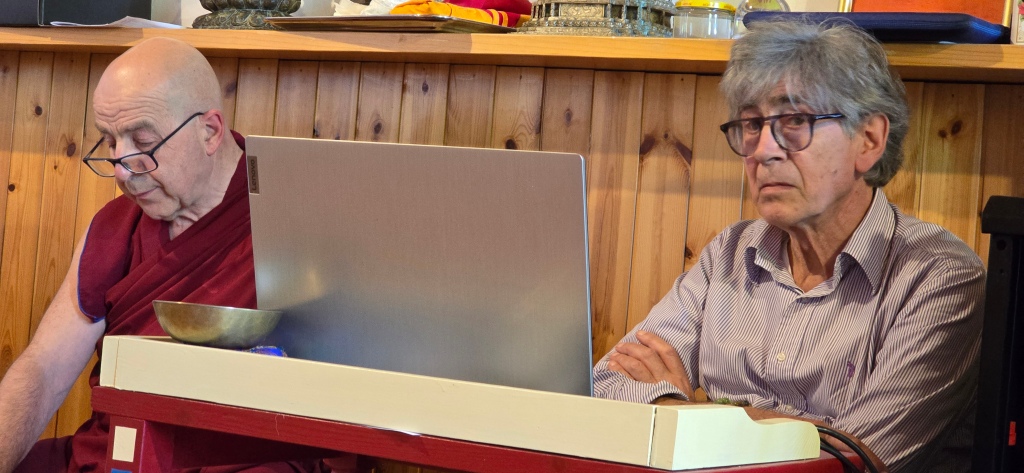
Venerable Geshe Jampa Gelek and his suite (Venerable Raffaello and Translator Davide Lionetti) arrived late on Friday evening, and they were hosted by the lovely Cristina, my colleague from the Master Program at Lama Tsongkhapa institute, in her wonderful house situated a little outside Treviso, in a most charming landscape. My heart rejoiced at seeing my spiritual master once more. Geshe Jampa Gelek is one of the two resident teachers at Lama Tsongkhapa Institute in Pomaia, Italy, where he teaches the Master Program, among other lectures. Currently just finishing an extensive presentation and commentary of the Ornament for Clear Realization, Geshe-la is a rare jewel of wisdom and compassion in our world and we are very fortunate to be able to attend his teachings, online and in-presence.
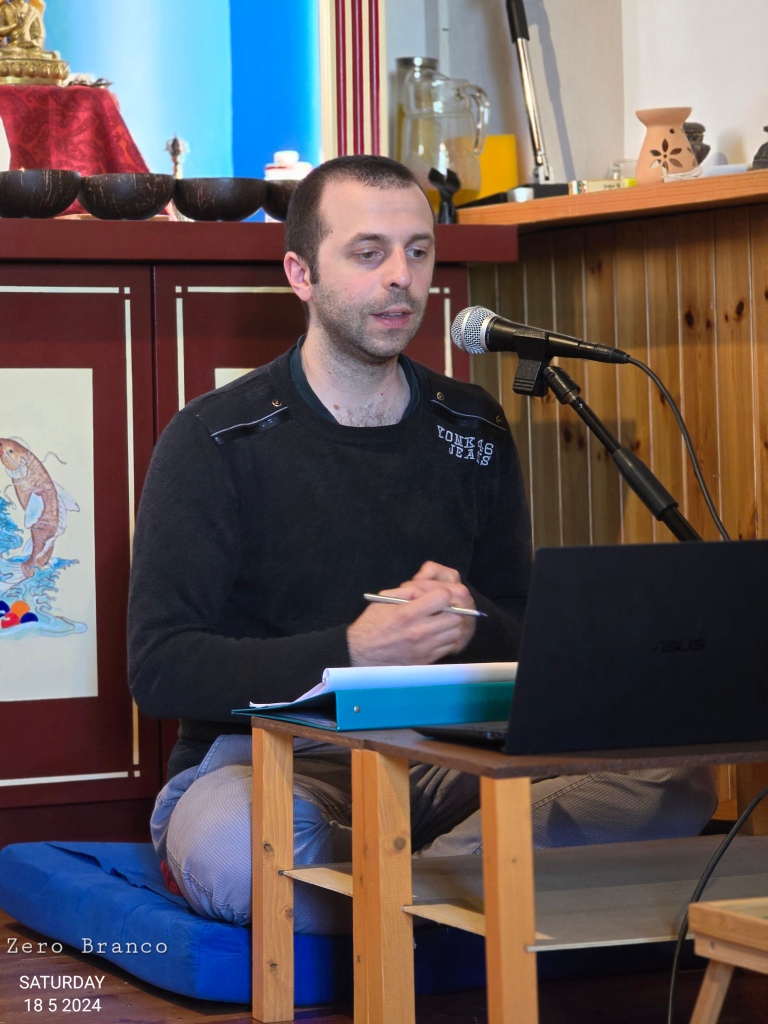
Guru Puja and Teachings at Zero Branco. We reunited the next day in the morning for the Guru Puja ceremony held at Lama Tzong Khapa Buddhist Center at Zero Branco, a little village with a most interesting name!
Zero Branco has a rich history that dates back to Roman times. The village’s name is believed to be derived from the Latin word “securis” (meaning axe) and “blancus” (white), reflecting the area’s historical connection to woodcutting and the presence of the Brenta River. The Center’s director, honored Danilo Ghirardo, had carefully prepared the room for the ceremony and the teachings that we were blessed to receive from our venerable Master, Geshe Gelek.
Dreamtale. The teachings of the two days centered around Nagarjuna’s Dreamtale (it. Racconto del Sogno, tib. རྨི་ལམ་གྱི་གཏམ). The main concepts discussed in this remarkable text are emptiness (śūnyatā): Nagarjuna’s central philosophical concept, which asserts that all things lack inherent existence and are empty of self-nature; then, interdependence (pratītyasamutpāda): the idea that all phenomena arise in dependence upon causes and conditions, highlighting the interconnectedness of all things; and last, but not least, mind and perception: an exploration of how the mind constructs reality, emphasizing that our perceptions are not necessarily reflective of true reality.
The intention of this article is not that of going into the depth and detail of this text, but to highlight some of the most beautiful, most heart-warming excerpts of the teaching given by the Venerable Geshe Jampa Gelek.
*
When we talk about the word mind, someone’s mind, we mean the person in general; some people make a clear distinction between me and others, between themselves and others, therefore between me and others. So what happens in this way? We feel attachment to ourselves, aversion to others or in any case attachment to those we feel close to us and aversion to those we see as far away, this attitude of far, close, me and others, therefore attachment and aversion. So what is said in the text is: I will not do this way and therefore without acting, without having this way of thinking, I will see all the sentient beings just like me; the sentient beings are me, they are myself, in the sense that they are equal to me in desiring happiness, they are the same as me in not desiring suffering.
*
Sentient beings should not be harmed. For example, when someone harms us, our parents, peers, or children, we feel sad and experience something we don’t want. We talk about accepting these harms we receive. The meaning here is that when someone causes harm to us or our loved ones, we suffer and are unhappy. Similarly, if we were to harm others, they would suffer in the same way.
On one hand, it is about accepting the damage done to ourselves and those around us. On the other hand, it is about not responding in kind, and refraining from causing harm to others. In mental training, a similar principle is taught: to take upon oneself the evil done to oneself and not to hurt others.
*
With an attitude of benevolence and patience towards sentient beings who commit serious negativity, and with constant respect for them, one refrains from committing the slightest negativity. But what does this mean in practice?
Consider someone who commits a truly bad action, a crime that is typically punished severely—something we regard as a very serious offense. When someone commits such an action, the practice recommended here is to meditate on patience. This involves not only refraining from anger and retaliation but also cultivating a wish for the person’s happiness. Instead of seeking revenge, one generates thoughts like, “May this person be happy, may they feel joy.”
So, on one hand, you practice patience, and on the other hand, you foster a desire for the well-being of the person who wronged you. If you cultivate this mindset consistently, you won’t harm this person or anyone else in the slightest.
Patience involves getting accustomed to enduring small irritations and problems. By becoming used to minor annoyances or small harms done to us, we gradually develop the ability to endure more significant wrongs. For instance, if someone is causing us minor problems, we start by meditating on patience, learning to endure these minor evils. Over time, this practice strengthens our capacity to handle more significant and severe harms.
Therefore, the practice is to meditate on and cultivate patience, beginning with small irritations and gradually building the ability to endure larger and more serious negative actions. This way, we train ourselves to maintain a peaceful and benevolent attitude even in the face of significant adversity.
*
When we are born, our first connection to life begins in our mother’s womb, marking a phase where we entirely depend on her. Upon birth, our dependency extends to other sentient beings. Initially, our survival hinges solely on our mother, but as we grow, we rely on a broader community. For instance, to have clothes, we need people who make and sell them. Without these individuals, obtaining clothing would be nearly impossible.
In fact, almost everything we possess depends on others. It’s exceedingly rare to have something that doesn’t involve someone else’s effort. Our very existence and ability to sustain ourselves are intricately linked to others. If we had to live entirely independently, without relying on anyone else, survival would be impossible. We depend on others to live and thrive in this world.
*
Most of our problems arise from dividing ourselves from others. This division leads to attachment to ourselves and aversion to others, or attachment to our own perspective and aversion to the perspectives of others. It is from this basis that all problems emerge.
Conversely, if we think of ourselves and sentient beings as the same, viewing them as part of us or just like us, we foster a sense of unity. The opposite of this mindset is to consider oneself as the most important, a perspective we have held from time immemorial. By thinking of all beings as just like us, we cultivate the opposite attitude, considering others as important. With this way of thinking, we can quickly achieve positive results and happiness. Without it, we will find neither goodness nor happiness.
*
It is said that even a small thought of benefiting others results in a benefit to oneself. Practicing small acts of kindness towards others benefits us in return. Conversely, even a small amount of harm done to others causes significant harm to us. When we benefit others, even slightly, we receive some benefit. When we harm others, even slightly, we receive some harm.
Thus, all our happiness and suffering depend on whether we have been beneficial or harmful, or if we have harbored thoughts of benefiting or harming sentient beings. Our happiness or suffering is directly influenced by our actions and intentions towards others.
I am going to end this article with a beautiful excerpt from Nagarjuna’s Dream Tale – a short fragment in Tibetan and English – timeless wisdom on which to meditate.
བདག་དང་སེམས་ཅན་ཐམས་ཅད་བདེ་སྡུག་མཚུངས།
བདེ་སྡུག་མཚུངས་པ་ཅན་ནི་གཉེན་ཡིན་ན།
I and all sentient beings are equal [with regard to] happiness and suffering.
Being equal [with regard to] happiness and suffering, we are family.
A few words about the translator. As a learner (still) of Tibetan language myself, whenever I see a fellow translator doing the impeccable, most difficult work of translating from a Dharma Master, I am in awe of their skill and insight. Davide Lionetti is no exception; moreover, he is one of the best translators I have ever witnessed. Sincere congratulations, Davide, it is a privilege to have met you!
We extend our profound gratitude to Venerable Geshe Jampa Gelek, to director Danilo Ghirardo at Treviso Center, to all the participants and sponsors who made this possible. Until we meet again!
Kindly visit the website of Lama Tsongkhapa Center in Treviso and consider attending the teachings and events, as well as supporting them financially:
On this earth, there are people who do not accept religion, and those who do. But at the end of the day, what all people on this earth want – is happiness.
I want to say that we, as human beings, are very special compared to other creatures, other living beings. We are exceptional because we have human intelligence. And with this intelligence that we have as human beings, we can do so much. We can learn so much. And also, we can understand so much. And this is only possible with human understanding, with the human consciousness. This means our human mind has great capacity.
Then another aspect that I want to present is that we have happiness, and we have suffering. When we talk about happiness or suffering, we have to know that these exist at two levels. One is at the level of body consciousness, physical consciousness. Then, another level of happiness and suffering is at the mental level. So, the mental sensation and body sensation are those two things. For many living beings, such as the animals and so forth, they experience a lot of suffering that is related to their body consciousness, the physical consciousness. As for human beings, we don’t experience only that. We experience something more. On top of the body consciousness, we also experience the sensations of mental consciousness.
So this means we, as human beings, go through more complicated, more complex sensations, more complex happiness, more complex sufferings also. The animals have only limited capacity, and that is enough for them. So we, as human beings, have more mental capacity, but also more happiness and more suffering.
Human beings produce many material objects, many technological objects. And then… regardless to all these developments, we always want extra, always more and more stuff, more and more happiness. So the developments of material objects do not really change our sensation.
So this means that, for human beings, it’s something to do with the mind. No matter how rich you are, no matter how rich or poor people are, it doesn’t really matter so much; the mental level of suffering, mental level of happiness does not change a lot. It’s very subtle, you know.
Human beings have so many thoughts, conceptual thoughts; our mind is constantly thinking this and that, which creates extra suffering on top of the natural sufferings. You know, this is why many times, we as human beings, due to not knowing or because of not knowing how to take care of our mind, then we have more suffering and, unfortunately, more unhappiness.
Then, you know, people often ask the question: why are we born? What is the purpose of our life? That question is in our mind, you know? So, at the end of the day, we ask the question, what is the purpose of being born?
This is a very important question. So the answer is that – if we are born as human beings, the purpose of our life is to establish the cause of happiness. This is the purpose of our human life, the one that differentiates between human life and animal life. Otherwise, if we don’t do anything, if we don’t reduce suffering, if we don’t search and establish the cause of happiness, then at the end, it’s like we become like the animals. This is why, as human beings, we have this purpose, we have this responsibility to make something better. So this means we have to know what the mind means. To establish the cause of happiness, we have to also understand how the mind works, and what is the nature of the mind. So we have to learn these subtle things so that we develop, we improve the quality of our mind.
So now I will share with you a little bit of my own experience as a Buddhist monk. I’ve gone to monastery to learn about mental functions, about how our mind works, the different aspects of minds, the minds and mental factors. So I’ve learned this subject for about 40 years. I’ve been quite fortunate, I managed to have less tension, to have less stress – not only through learning about the mental nature, but also through teaching this subject to people, to the Westerners and to my students in India and Nepal.
So, from my point of view, when we learn what the mind is, how the mind works, and so on, it really is helpful.
In the Buddhist texts, we talk about two categories of phenomena, or two classes of phenomena. First, we have phenomena that are compounded: what does it mean? Compounded phenomena represent any object or any phenomenon that is produced through different compositions of different causes and different conditions. So, anything that is produced from many conditions and causes is called a compounded phenomenon. Our consciousness, our mind belongs to this category.
Then there’s a second category of phenomena: uncompounded phenomena: a phenomenon which has arisen, which has come into existence, without depending on causes and conditions; the mind or the consciousness does not belong to this category.
So having said this now, on the flip side of the compounded phenomena, we have three categories: one division is called the form, the other division is called the consciousness, and on top of this, again, there is a third division called the non-associated phenomena – objects which are neither consciousness, nor form. So within these three, we can say that even ourselves, as a phenomenon, we belong to one of them.
What is mind? What is consciousness? Consciousness is not a physical object. It is completely free from being a form. It is just that which experiences. It is a mere experience. It is a mere perception. When we first start learning a philosophical topic, we ask ourselves, what is the mind? Then we are explained that within the mind, there is clarity and there are perceptions. So it is something clear and it’s just the mere effect of knowing. This is the mind; we cannot show the mind. It is something non-physical, yet it has the power to recognize. It has the power to know something. It has the power to feel something. So this is the mind. And this mind is the mind that we all have.
Our human mind is much more developed, compared to the mind of those animals. This is why our human minds create many more sufferings than the sufferings of the animals. Animals don’t have this complex mind. So they live at a very simple level. So what I’m saying is the mind needs also more care. We need to take care of it more. If we don’t take care of it, then the mind always goes on and on with so many complex sufferings and unhappiness. This is why, as a human being, we have the task of improving, making this mind better.
When they talk about form, scientists know much more than, a Buddhist philosopher. They’ve developed, they’ve learned what the world is, they’ve studied everything that is to be known in the world. But then when they come to talk about the mind, then they really don’t really know so much. They don’t even know what the mind is. So this is why we, as followers of spirituality, have this burden or task to learn more about this, and to take care of the mind.
OK, now, the main point here is, you know, OK, to say, oh, there’s mind, of course, it’s easier. But then now to prove how the mind exists and in what way, this is the main question now here. So in Buddhism we say like this:
The mind exists. Why? The mind exists because our present life exists. Our present life exists because we have come from a past life. That past life came to us, or we came from the past life to here, through one state called the intermediate state. Intermediate state means a state that is between the past life and the present life. And this in Tibetan Buddhism we call the Bardo state.
The Bardo state is a state where our consciousness is moving here-and-there, up and down, traveling throughout the whole universe to find a place to be born; after a long, long time, the mind suddenly finds a specific union where a female and a male person make love. In the union, there is the unification of the eggs, the woman ovule, and the man’s sperm. So, at that time, if there is no consciousness, nobody can take a rebirth at that time, because the rebirth comes only from the entering of the part of consciousness at that moment.
In this way, we are born, we grow, we become adults; we have an ordinary mind, and then this mind then has its own quality, its own characteristic. So, the quality of a mind is that it gains certain knowledge once one has familiarized or acquainted oneself with the past objects – which means, if the mind has familiarized itself with something in the past, then the mind is able to remember things, to know things without any limit, because the mind has no physical limit; the more we familiarize ourselves with things, the more we learn. Because if we have familiarized ourselves, then the mind remembers and knows without any future effort. This is the quality of mind.
So what I’m saying is the mind really has its own special quality, its own spontaneous quality, that once the mind has known something in the past, it has a very spontaneous acquisition of quality without further effort. The more we learn, the more the mind can learn more. It’s not like physical exercise. At level of physical exercise, what happens? We all know, at the Olympic games, when people do the long jump, they always need future effort. For example, someone, man, or woman, in the Olympic game, they make the long jump. Maybe in the beginning, they make five meters jump, you know. Maybe then again, next time, next year, they will make six-meter jumps. But at certain point, somebody’s reach is maybe 10 meters, let’s say, after that, it’s impossible because that is the maximum limit. So this is the quality of physical, the physical level is limited. After we reach some kind of limit, we cannot do more. This is the point.
The mind, once it has learned, it doesn’t need effort. Also, I can take one more example. When we do, when we boil water, you know, you all know how it works. The temperature, the maximum temperature is at 100, 100, 100 degrees. When that level is reached, what happens? The water disappears. Or the water boils. More than that, there’s no other, you know, there’s no other miraculous result. That is the limit and that’s finished. So either the water disappears or the water boils and there are no other stages to go through. Whereas with the mind, we learn, we learn and learn. After a hundred years we learn, and the mind still has more and more ability. This is the special power of the mind. So, as a human being, we can always learn, and there’s no limit. This is the point.
So at the end of the day, what I’m saying is: once the mind learns and knows all, then everything becomes easy, you know. You know, people usually say, oh, this is difficult, oh, this is easy, you know. So, all this, at the end, all this is a question of, question of acquaintance, question of familiarity. If we have the familiarity with some subject – like mathematics, maybe singing, maybe dancing, if we familiarize ourselves, everything is learned, everything is possible, you know? So all this difficulty or easiness is a question of how long, how much familiarity we have. So if the mind learns, the mind is able to just go on and on. So even the great Shantideva in the Buddhist texts would say like this: there is nothing that doesn’t become easy if we familiarize ourselves with this.
We always find excuses saying: oh, this is difficult, I cannot learn, but this actually is just a question of getting used to it. If we get used to it, everything is possible. So it’s a question of just training and familiarity.
Another particularity of the mind is that – when our sense consciousness manifests, only one sense consciousness is active. When one sense consciousness is active, the other sense consciousness cannot arise simultaneously. This is not possible; while one of them is active, the other becomes dormant. Dormant means like sleeping. So the other sensory consciousnesses are a little bit in a dormant position. So that is the way our mind works you know from day to day or from moment to moment. One moment one sensory consciousness is active, it’s manifesting. The coming moment another kind of sensory consciousness is active, and the past one maybe remains dormant. So this is also another point of view about the mind, how it works. So this means, oh, we cannot say all sensory consciousness are active simultaneously. This is not possible.
Why do we have suffering? The suffering does not stop. And now the question: why do we have stress? Why do we have worries? Why do we have a mental lack of serenity? Why do these things happen? And the answer is, as a human nature, unfortunately, I should say, unfortunately, our minds keep producing more and more thoughts, like, or extra thoughts.
So when these things happen now, what is the solution? Otherwise we say this and that, but then we always need a remedy. So what is the remedy to calm down, to reduce these sufferings, or these worries, these like stress we have? What should we do?
One technique, from Buddhist point of view, is to do a meditation on the breath. The breathing meditation. It’s a simple technique. It doesn’t need so much knowledge. During that time, during the breathing meditation, you don’t think of anything. In that way, your stress and your preoccupations, they subsidize, they become very inactive. So if these mental creations become inactive, that means also our stress and our mental tensions and stress also become inactive. So if they become inactive, this means we have less suffering, less problems at that time. At least, not for the whole life, but at least for that moment, for that day, it is reduced. So this is the one solution that I would propose, you know, from my experience.
Breathe in – breathe out. Why do we do this? What is the purpose? The purpose is, when we calm our mind, when we try to reduce the busy-ness – (usually our mind is always busy: this and that, this house, and my works, and the woman, and the man, and all this relationship) – when we focus our mind on the breathing, at least during that time, the mind becomes what we call neutral, the mind takes neutral position – neither unhappiness, nor happiness. The mind rests in a neutral state. So, when the mind is neutral, then somehow our mind is ready to do a prudent meditation.
If we say, oh, I want to do fast, fast meditation doesn’t work. We must start from a neutral position, like driving a car. When we drive a car, we have to put the gear in a neutral position. Also, we put the mind in a neutral position. In that way, we control our mind.
And then, when the mind is ready, then we can go or we can do another level of meditation, a higher level of meditation,
But then also, when doing the breathing meditation, if you are not calm, if you are not peaceful, it’s difficult to do the breathing meditation. So to do the breathing meditation, the body has to be kept in a certain position. And for this, in Tibetan Buddhism, we have one particular topic called the seven-point body posture of Buddha-Vairochana. Because when we do the meditation, if the body is put in certain position or posture like that of the Buddha-Vairochana, then it is a very positive condition. It’s very favorable for meditation to be better. If the body is not in the right position, if you work, if you move, this is just impossible. This is why a certain position is necessary.
When we maintain these seven-pointed body posture, why is this so important? The answer is, it is important because when the body is correctly positioned, it helps the body channels also to be in the correct position. If the body channels are correctly positioned, it is important for the mind-flow. The mind flows very easily when the channels are correctly positioned. We have different kinds of channels. The growth channels, the subtle channels and so on. And within the body we also have gross consciousness, and subtle consciousness. So the point is, when the body is correctly positioned, it helps the channels to be to be in a good position.
The first posture is called the full vajra position, or half vajra position so this means: crossing the legs out to each other and then sitting down, this is a full vajra position. And half vajra position is the usual way that we sit down with one leg a little bit open. So, in sutra we have this posture with the full or half vajra position. And what is the purpose? What will we get? What will we obtain as a result of this? And the answer is, if we keep this position, it helps us attain the four levels of results in Tantra. Tantra is another complex subject. So to have that as a result, we already make some kind of connection, some kind of you know a cause. So when we take this full vajra position or half vajra position we create the cause to have those Tantra results in the future.
Then, the second position or posture is the two palms joined at the level of the navel in a mudra. Mudra is a Sanskrit term. When we join our two palms at the level of the navel, with the two thumbs join up, then this helps us to have a single-pointed concentration in the future. To gain concentration is great, but then, you know, even at a physical level we need to create some kind of condition, you know, some kind of small cause. So by doing this, it helps us gain equal placement realization in the future. So, the point that we join the two thumbs, you know, at the level of navel, is also to create the condition to have the realization of tummo.
Tummo means inner fire, inner heat; we don’t have tummo right now, but we create the cause and condition to have tummo realization in the future. This is the point.
Then, the next position is to keep the back spine straight. The spine has to be straight, like a bamboo; what is the purpose? And the purpose is, we in the Tibetan Buddhism, we say that we have the so-called central channel. So the central channel also becomes straight by keeping the spine very straight. So if that central channel is straight up, like a bamboo then that means that allows our wind to flow easier.
And then, the next position is to or leave our lips in a natural position. That means that our lips, upper lips and the lower lips, the mouth, shouldn’t be mortified, no? Or to leave our mouth as it is. At the same time, also it is suggested that our tip of the tongue slightly touches the palate. The tip of the tongue touching the palate. In that way, the mouth is kept in a very natural position so that it is favorable to have a long meditation without becoming thirsty time. But if we keep this position in this way, the swallowing of the saliva also becomes less.
Next, have the head slightly bent forward. By keeping this position, we create the cause to have a particular result in Tantra – the realization of verbal isolation in Tantra. This is one kind of realization in the future in the tantra. So to have this, we then try to make this position. So this is just making a favorable condition. This is all.
Then the next position is the position of keeping the eye view, towards the tip of our nose in a natural way, so that our eyes are not open wide. Because if our eyes are totally open, then of course we have so many distractions, seeing movements, objects, people moving around, maybe cars, and so on. So the meditation wouldn’t be good. At the same time, the purpose of keeping the eyes slightly open is to avoid falling asleep. Because sometimes people think they meditate, but maybe they are sleeping. So this is also another thing that we should be careful of. So the eyes shouldn’t be completely closed. Also in this way, the recommendation is that we look at the tip of the nose, and in that way, the meditation is kept under our control. In this way, we also avoid the obstacles called excitement and drowsiness: mental excitement means mental sleeping and. So these obstacles would be removed when we have this position. The two shoulders must be equally positioned. In that way, somehow, keeping the shoulders in the same position and also trying to have some kind of small space under our armpit. Our armpit, you know, if there is some space then maybe it makes the body always fresh without again any energy to fall asleep. So this is the purpose of this last body position.
When we maintain this body-position, somehow it also creates some kind of positive energy for other people. If other people see you, they at least maybe feel positive, or maybe thinking, this person is doing meditation, we don’t disturb, we let them do it. If somebody really does things in a proper, good way, sitting, doing meditation in a proper way, somehow it creates serenity. It creates peace and serenity even for other people.
While doing the breathing meditation, it is also possible to add another practice called the practice of Tonglen: this literally means giving and taking. What are we giving? While we exhale, or breathe out, we imagine that we share, that we give our happiness, our good energy, our positivity to the others who are in need. And when we inhale or breathe in, then we take. What do we take? There are people who really have big pain, lots of suffering, obstacles, and so forth. So then we try to reduce those, to help them, at least in the imagination, you know, to take their sufferings to ourselves, by means of our breath.
OK, then now when we do this practice called Tonglen, of course we are not really doing, you know, at realistic level, we are not really doing things. No, we are not really giving. And we are also not really taking. But then what is the purpose? The purpose of this is to mentally improve ourselves. Everything is a question of training. Everything is a question of learning.
When we practice Tonglen, mental giving, giving, giving, giving, or taking, taking sufferings, somehow it intensifies or it helps psychologically, it prepares us to be able to also physically do it one day in the future. So, when somebody does this kind of Tonglen meditation, especially people who do social service, people who do nurse job, people who do doctors job, people who do anything that is social, it makes their mind much better. Maybe somebody is doing social service but not happily. They only do this to do their job, earn their living, but they don’t really do it with happiness. But if one does this Tonglen meditation, it makes the mind very happy to help more, to do the nurse’s job with a very happy mind. So this is like some kind of a way to prepare ourselves, to make our mind better and improve it and so on.
There are many ways to practice. The first way is to practice meditation.
In meditation, we have two kinds or two types. One is analyzing meditation, and one is stabilizing meditation. So concentrating or stabilizing meditation means that we try to focus our mind on one single object, on one single-point object without any other focus. This is the second type and it is called Shamatha.
Within the first type, we meditate but at the same time our mind moves, our mind investigates, our mind analyzes. This is called Vipassana. And then some people say: oh, no, the analyzing meditation cannot be meditation, this is not good, this analyzing means it’s not meditation, this cannot be meditation. Some people say it. Some people think or say, they say only the second time is the good one, because it focuses only on one single object, this is meditation. Some people say, but at the end of the day, it doesn’t really make any difference because we just said that there are two types, but then we don’t have to follow all those different kinds of statements. We follow certain scholars, certain philosophers who are competent. For example, among all the Tibetan yogis, there’s one yogi called Lama Tsongkhapa. So, he said that there are two types of meditation.
What does meditation mean? What is it? What is the meditation? What is the meaning? The question, you know? And the answer is meditation means to become familiar, to familiarize, to become familiar, the mind, our mind become becoming familiar with something. This is the meaning of meditation. So meditation is not different from familiarizing yourself with something.
Shamatha is stabilizing meditation. One tries to put the mind on one object, and then not thinking of anything. This is the Shamatha. Or we also can say this, we can call this the calm abiding. Calm abiding is the literal translation of the Tibetan word shi ne. Shi ne is a Tibetan word, shamatha is a Sanskrit word. So calm abiding means that one abides calmly with stability, stabilizing. So this means, in the end, what we need most of the time is the calm abiding. If we have the calm abiding first, then we can do the analyzing meditation quite easily. And this is why we have the Vipassana. Vipassana is the fact of analyzing subtly, the subtle things, like this and that, what is this, what is that, mentally checking. So, if we are given the option, what we should realize first, or what should we do first? The answer is, first we should gain the shamatha. Because without the shamatha, we cannot have a proper vipassana. Somehow the mind is running here and there; the mind is distracted. So if the mind is distracted, it’s just impossible to start analyzing meditation or Vipassana. This is why it is recommended to realize first the calm abiding or Shamatha, and once you find that is quite strong, once made it like stable and firm enough, then we can, you know, go to the Vipassana side.
Now, to help ourselves, how do these two things work together? To help us, we can take one example, very practical.
Imagine a large aquarium with fish. If the water is moving, then it’s not so easy for the fish to move. But if the water in the aquarium itself is very stable, not moving, then it’s also very easy for the small fish to move inside in the water. So this means we need to make sure that there is no wind, that there is no movement of the water pushed by the wind or moved by somebody. So is the mind. We have to make sure that a state of calmness has been acquired, that the stabilizing meditation has been done. When the water is calm, without turbulence, then all the small fish inside can really swim without any difficulties.
In our society, in the West, in the East, everywhere, people are attracted by Shamatha meditation. Why? The reason is very simple. Because all people enjoy the lack of agitation. All people are looking for some kind of peace. Peace is found through the Shamatha meditation by blocking all the different kinds of excitement, agitations. So then, somehow, when people find that peace, at least during that time, people find some kind of happiness. People find the equilibrium in themselves by blocking all the different kinds of colliding thoughts, the mental moving. Many of the problems in our life, as we said before, come mainly from the mind. The mind is not calm, the mind is out of our control, the mind has some kind of tension, the mind has some kind of preoccupation due to work, due to relationships, due to this and that. So whenever the mind is out of control, then unfortunately, peace is not there. But when people find themselves in a program of Shamatha meditation, they all go. So to find peace for some days is also good enough for them. So this is why stabilizing meditation is important in this sense. When people have gained some level of mental peace and mental stability, then there is space to gain some kind of more wisdom, to gain insight into the possibilities to make the wisdom sharper, by analyzing the nature of phenomena. How does the mind function? How does the mind work? So, this kind of analyzing, analyzing this kind of movement, this kind of sharpening of wisdom, this comes easily if the stability of the mind is accomplished. If the mind itself is never stable, if the mind itself is agitated, then analyzing is out of question. It’s just very difficult. So to be able to make that part, the wisdom of sharper, we have to push, try to put effort to have to gain this mental calmness, the calm abiding.
Having said this, the next level of understanding about the mind is to ponder over the conceptual thought, the mental consciousness, the gross consciousness. Gross consciousness refers to the sensory consciousness: our eye consciousness, our body consciousness. So, we say in Tibetan, the consciousness of the five doors. Five doors of what? Not the doors of our house, but the door of our sensory door. Sensory door means the door of our eyes, the door of our nose, the door of our ears, and tongue and so forth. So, there are five sensory doors, and each of these has its own respective consciousnesses. And these five sensory consciousnesses are gross consciousnesses, gross or coarse consciousnesses. Why? Because these only perceive something physical. And on top of that, the forms of the physical objects are only present time. This is what is realized by the gross consciousness or the sensory consciousness.
The next level of consciousness, what we call the subtle consciousness, is referring to mental consciousness. Mental consciousness means something subtle, something that we cannot see, yet it is there in ourselves. So this mental consciousness doesn’t only capture the present, but also the future objects. It deals with the past objects, you know, conceptual thought or memory, remembering past objects, past times, yesterday and so forth. So this is the function of the mental consciousness. The mental consciousness has a much deeper level of work and function to do. Whereas the sensory consciousness only deals with the present, right now. We see now, we hear now, or we sense now with the nose, only with the present time. Whereas the mental consciousness has a much vaster movement: present, past, future. So this means the more we deal with consciousness, the more subtle realization we gain about the subtle of the subtle mind.
What does it mean? It means our thinking, our thoughts, are consciousness, and not something related to our senses. The subtle mental consciousness, the subtle conceptual thoughts, they are related to our brain. So when the brains are clogged, these conceptual thoughts, some of them do not function. So this subtle consciousness can function as long as the brain is healthy. But if some of them are damaged, then there’s some difficulty.
When we meditate on the mind, more and more, the subtle mind becomes subtler. When we die, during the three days after the last moment of death, the last three days, the extremities of consciousness manifest and that is what we call the death’s clear light. So that is the most subtle consciousness, or the most extremely subtle consciousness, that continues from one life to the next, and next life to the next life, and so on.
When people die… unfortunately, we all have to die, okay? So don’t worry about this. So so when we die, all our gross consciousness stops, okay? Gross, subtle, everything stops. Only the extremely subtle consciousness remains. So for an ordinary person, the extreme levels of consciousness only appear at that time, at the last moment of death. But for somebody who has practiced yoga, who is doing good meditation or deep meditation of tantra and so on, then these people, they reach some kind of level of realization called isolation. Mental isolation, the clear light of mental isolation. So when a yogi reaches that level without dying, he can make his extremely subtle mind manifest. This is also possible. So there is no need to die to have extremely subtle mind to manifest. So if somebody becomes a yogi and somebody has reached a level, it is also possible for this external sort of mind to manifest. But usually, for ordinary people, it’s only possible when they die.
So according to my knowledge, from what I’ve learned, the study of mind is very, very vast. It’s not something you study for two days, two, three days, two, three years. It’s really deep. So the science of mind is very profound. Different levels of mind, different levels even within the subtle, different levels of subtle consciousnesses. And when the mind becomes subtle, they realize different levels of objects. When the mind grows, they realize different levels of objects. So each level of mind, depending on which level they are, subtle or gross and so on, realize their own So, this means, you know, in the Buddhist study of the mind, there is a complex way of learning, you know. Usually we call this just simply the mind and its functions. This is the topic, this is the name of the topic, you know, mind and its functions. So this means, mind itself is one and the function is one thing. So the function and mind, and between these two, there are many divisions. Subtle mind, gross mind, and divisions of that mind. And the mind becomes these mental factors. So each of these has its own objects and functions and so on. So it’s really a subject of a long time.
So the mind is so subtle, so hidden, that we cannot really judge. If we talk about body and speech, something more gross, more visible, then we can give our opinion. Oh, that woman is terrible. Oh, that man is fantastic. So we can judge just by seeing the actions of the person’s body and speech. Because we see, we see, and we hear. So the body and speech are, something very simple, something very noticeable. But the mind, no. The mind, we cannot judge anything. We cannot infer someone’s state of mind. We cannot say he’s good or bad on the basis of mind, because we just don’t see. Because it’s too subtle, it’s too complicated.
This is the difference between the functions of the body and speech and mind. So this all means, to have a good heart or to have a bad mind or negative mind – all this depends on the person’s behavior. So, for that reason, we say it is important to know how to behave mentally, inside. In that way, people will learn it slowly, not immediately. We cannot judge immediately, but in the long term, it is possible to know something also from the mind.
So, as I said before, you know, with the mind we don’t have an immediate judgement, but with time, slowly, we realize how the person is. With a person, by living together, day by day, week by week, we realize how the person is. Because we don’t see his mind right away, we “see” the mind after a long time. After a long time, we see that person, how he is, how she is. When somebody has a good mind, when somebody has a good heart, slowly we realize. We don’t see right away, but after some time we see how the person is, then we say, oh, she’s a fantastic woman, a very good-hearted woman, because she shows the compassion. So then this is the mental quality, the mental quality of mind.
When we talk about love and compassion, we also have some confusion. Oh, this love and compassion. What does love mean? What does compassion mean? But in fact, if we think carefully, it’s very simple. Love means that we wish other people happiness. This is the meaning of love, you know. And then compassion means that we wish the other people not to have suffering. So, love and compassion… are very tricky, no? Depending on how we see it, both are always regarding other people, but one is related to suffering, one is related to happiness, no? When you want other people to have happiness, that is love. When you want other people not to suffer, this is compassion. So this is, of course, a quality of mind, the mental qualities are shown by living the life together with the people. Then we can say, oh, she is good, he is bad, or this and this and that. So this is possible only by experiencing the life together with the person. For example, when we talk about love and compassion, it is actually based on some kind of logic. It’s not just, I develop compassion, I develop love, just like this in this space. We generate love and compassion on the basis of some kind of reason, you know. We generate love because we somehow, we all, doesn’t matter, you know, if it is animal, if it is human being, we all want happiness.
So me, observing people around the world, news and so on, I see that people who have too much egoism, too much selfishness, they ignore the people around, they ignore the environment, they destroy the environment for themselves, they even destroy people. So this is, of course, unfortunately, the consequence of strong selfishness. But at the same time, we have worked on themselves. We have, let’s say, developed compassion. We have developed good heart, love. So then they share, they take care of other people. They take care of sick people. They take care of all the old people. So then they really have concern for other people. On top of this, these people so think of environment because they know that if they do something for the environment, this creates happiness for the people. So depending on how we move, if we have too much selfishness, then the result is always negative. But if we have the positive side, you know, loving and good heart, then the outcome is always quite positive. This is my observation.
Now I want to tell a short story now. I have one student coming from Tibet. He’s my good student, who was a monk, who came from Tibet. We have lived together. We have shared our life. I helped him. And then he has been a monk. And slowly, slowly, he has moved away from India, from the monastery. This means he is not a monk anymore. He is a layman now.
So, okay, then what happened now? He met someone, a Thai woman, and got married. So then they had children, of course. Then in America, you know, things are not free. People must work with sweat, you know. So he had their children. So then the mother from Thailand, she was quite busy with the children. She couldn’t go to work. And himself was the only man or only person, you know. So then one day, days two, the woman, my student, the Thailand woman, one time, one day, one time in one year, they went to Thailand for vacation to see the family of the Thai woman. So there, you know, the Thai woman, you know, they arrived there, and they saw the family, you know, the sisters married to rich men, hotel managers, hotel owner, I don’t know, real estate business and so on. So then, oh, my student, ex-monk, realized, you know, there’s such a big difference. And he even told the wife, saying, oh, my darling, all your sisters are very rich, you know, all these big men, they’re like businessmen, you made a mistake to marry me. I am poor.
Then, his Thai wife gave him a very, very touching answer. She said: “Oh, my darling, I am very, very happy with you. So I’m happy because you give me love. For me, this is what I need.” Such a, like, beautiful answer, you know. So this made my friend very happy. This is the real meaning of life. So this is something I think is true. If there is love, the rest is… okay, more or less, not perfect, but psychologically and mentally there’s so much peace, so much harmony. So I think this is really, I think, very good and important for life, you know, in terms of peace and happiness.
I tell you this, because since we live in a society, we all need human warmth, human respect, and human love. So this means, in order to receive this human love and warmth, we have to make the calls. We have to give our love to them. We have to share our life with them. We have to give our trust to them. So if we open our heart, if we share this with them, then, you know, automatically also the other people will also care for us. So wherever we live, we need to have this human warmth and human care, human love, And for this, we have to provide the cause.