
A report on the Groundbreaking Ceremony of the Bucharest Stupa – Garden of Maitreya, June 14, 2026
On the 14th of June, 2026, under a beautiful summer sky, the earth of Bucharest received something it had never held before: the beginning of a Stupa.
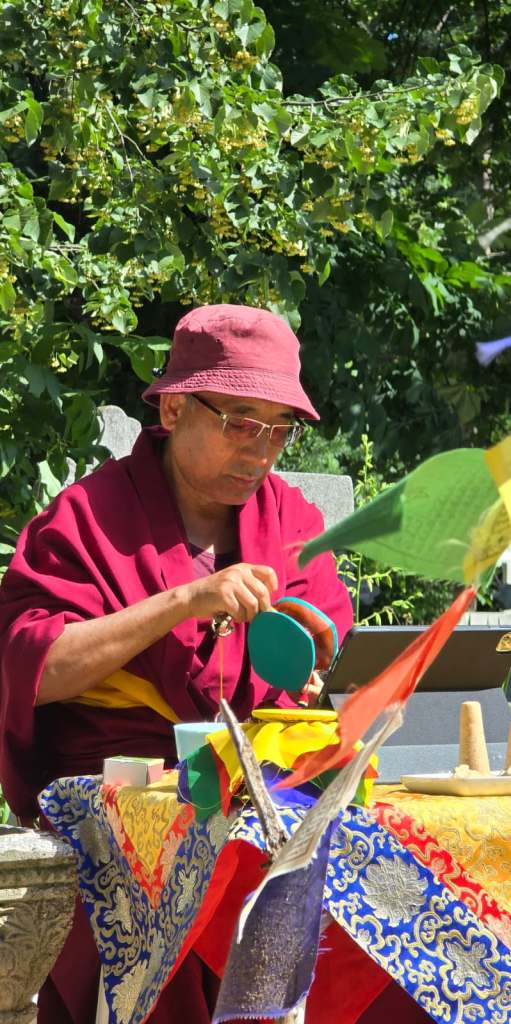
Led with remarkable kindness and patience by Geshe Thubten Sherab, the Groundbreaking Ceremony of our Stupa unfolded peacefully and succesfully. For those present, it was an occasion unlike any other – the moment a project carried in the heart for such a long time… finally made contact with the ground beneath our feet.
What Is a Groundbreaking Ceremony?
In the Buddhist tradition, breaking ground for a holy object is not simply a construction milestone. It is a complete ritual sequence – an act of devotion. Before a single stone is moved, the earth itself must be addressed.
The land we inhabit is not empty. According to Buddhist understanding, every place is home to beings invisible to ordinary eyes: nāgas, earth-protectors, local spirits whose realm overlaps with ours. To disturb the ground without acknowledgement is to act in ignorance; to do so with proper ceremony is to invite harmony, to establish auspiciousness from the very first moment of the project.
The Groundbreaking Ceremony therefore exists to do three things: to request permission from those who dwell in the earth; to purify and bless the site, and to establish the spiritual foundation upon which the Stupa will stand. Everything must done with care, because the seeds planted in those hours reverberate through the entire life of the holy object.
The Ceremonies
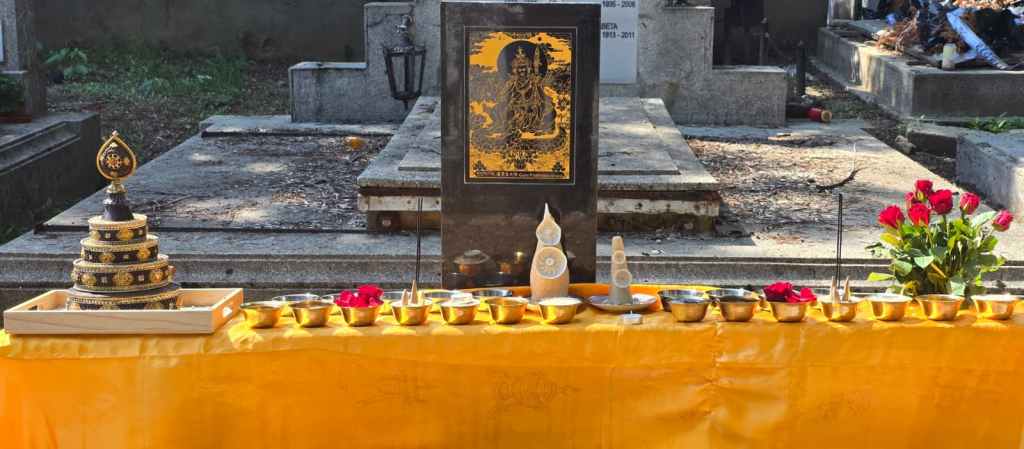
Offerings Before the Guru Rinpoche Plaque
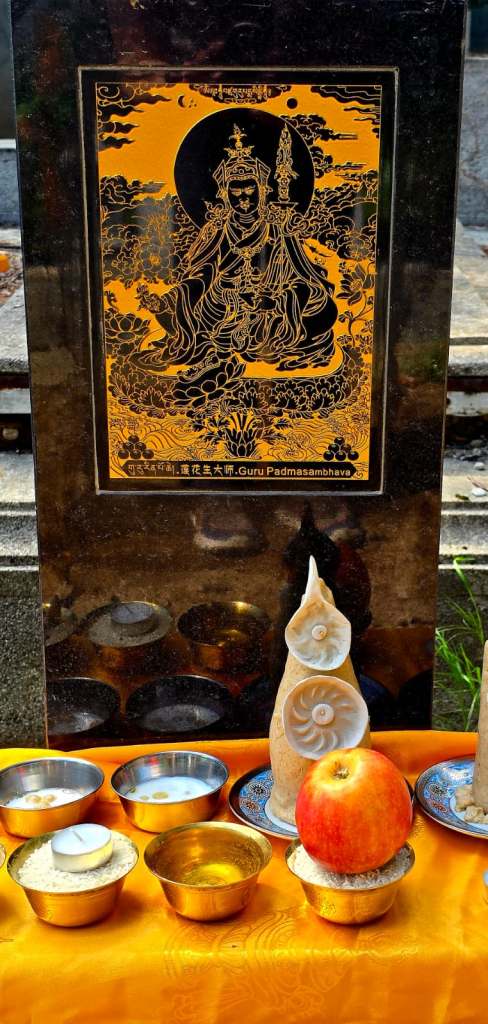
The ceremonies opened with offerings set before the plaque of Guru Rinpoche – Padmasambhava, the great master who brought the Vajrayāna from India to Tibet and whose instructions on the building of holy objects remain authoritative to this day. It was Guru Rinpoche who gave the precise specifications for treasure vases, who taught the methods for propitiating the earth beings, who outlined the immeasurable benefits of erecting stupas for the benefit of all sentient beings. His presence, invoked at the threshold of this work, was both a blessing and a reminder of the lineage within which the ceremony stands. For me as well, his presence carries a deep personal significance.
The Gektor – Casting Out Obstacles
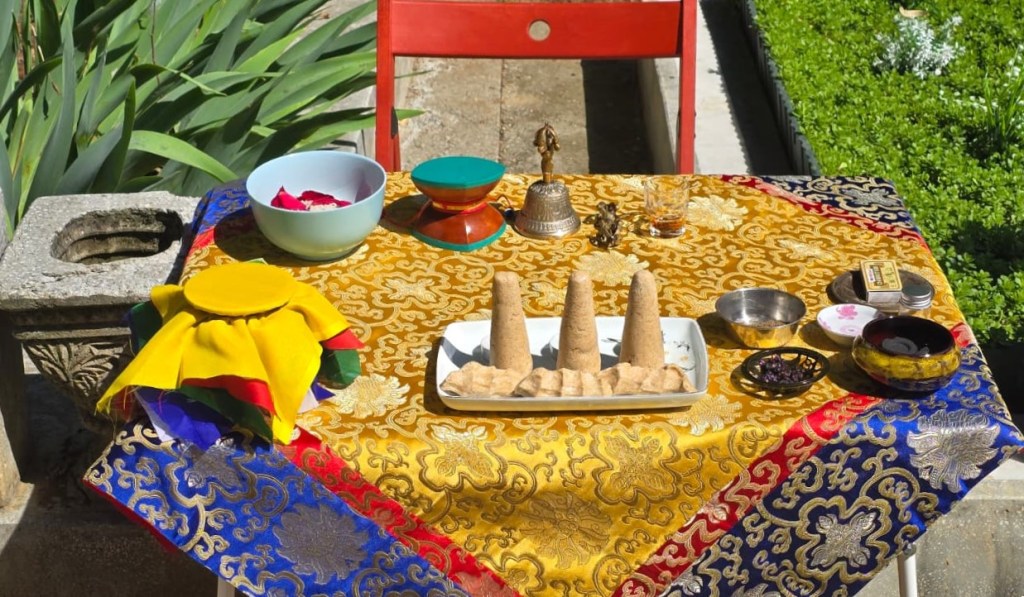
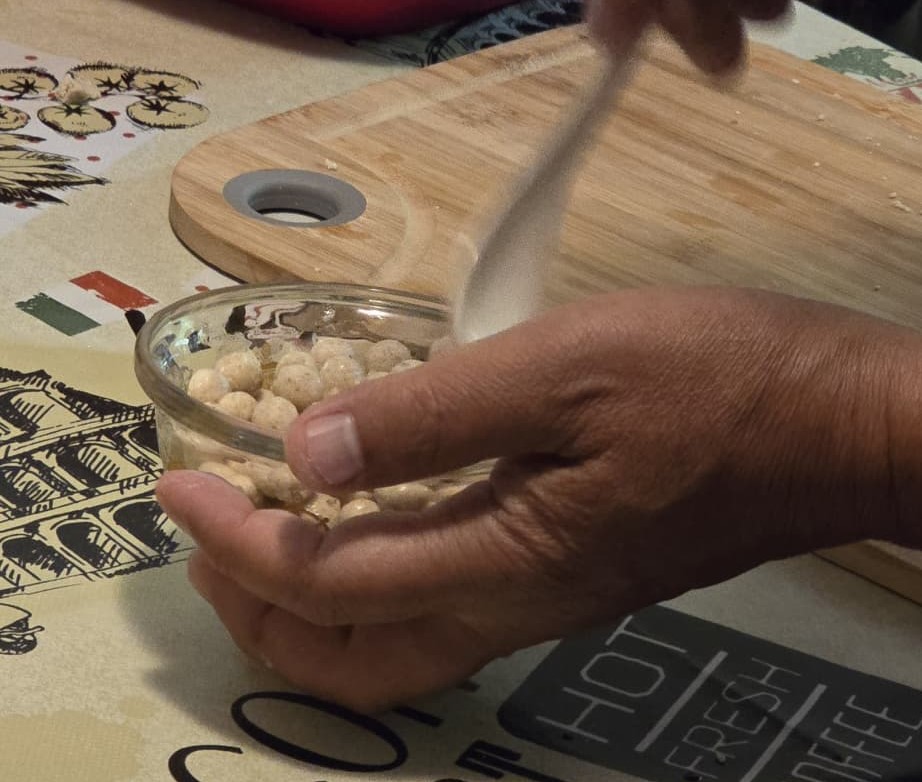
A gektor – ritual tormas made of tsampa and butter, moulded according to precise specifications – were offered as part of the obstacle-removal ceremony.
The gektor is an ancient and deeply meaningful element of Tibetan Buddhist ritual: it is offered to disruptive forces, harmful influences, and beings who might otherwise interfere with the purity of the work, asking them to depart, or to accept the offering and withdraw their opposition. It is an act of generosity even toward adversarial forces – obstacles are not… banished, but addressed; beings are not… expelled, but offered something in exchange for their cooperation. Pacified.
Offerings for the Local Spirits
The local spirits – the earth-protectors and place-holders of this particular corner of Bucharest – are the beings whose domain we enter whenever we break ground; their permission is not… assumed, but respectfully requested. This part of the ceremony is, as FPMT tradition makes clear in every Stupa project it undertakes, considered essential for the overall success and auspiciousness of the entire endeavor.
A project begun without this acknowledgement risks friction at every subsequent step; a project begun with it… enters the world with the cooperation of the unseen world, not its resistance.
Offerings for the Nāgas
A separate set of offerings was directed to the nāgas – the beings of water, earth and underground realms who hold particular sway over matters of environmental balance, health and the fertility of the earth. Nāgas are sensitive to disturbance; they are also capable of extraordinary blessing when properly honored.
In Tibetan Buddhist cosmology, appeasing the nāgas is not peripheral to a construction project – it is central to it, particularly when the ground will be opened and a permanent object placed within it. The offering to the nāgas at the Groundbreaking was an act of recognition: we know you are here; we come with respect; what we build, we build also for your benefit.
Establishing the Place of the Nāga Vase
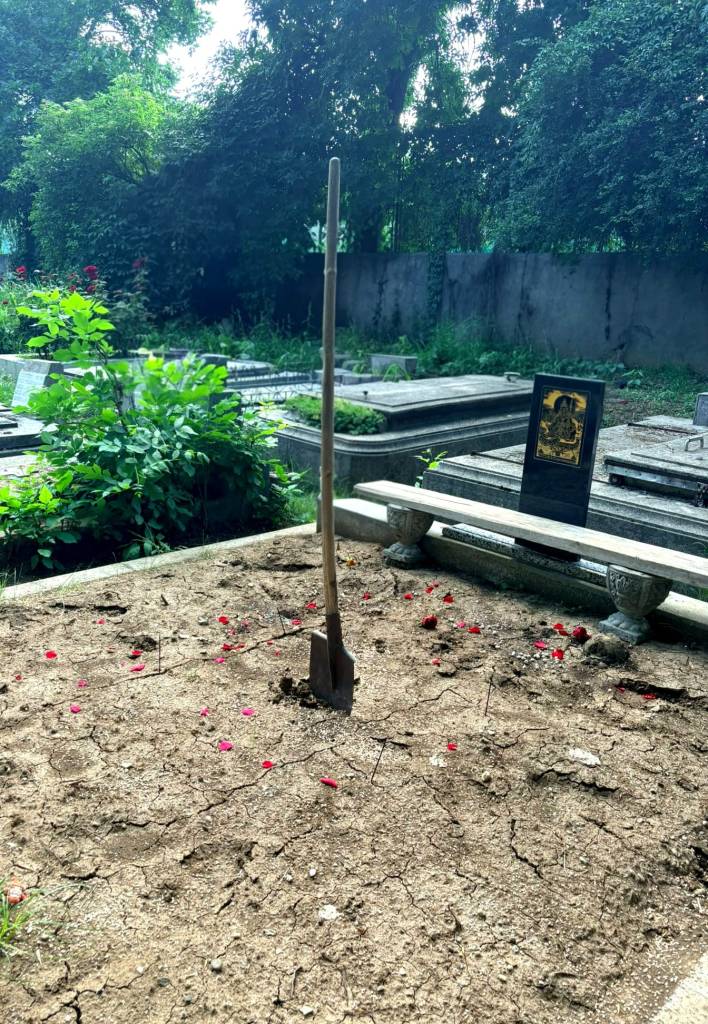
One of the most significant ritual acts of the ceremony was the formal establishment of the precise location where the nāga vase – will be buried beneath the Stupa’s foundation.
The treasure vase is a tradition traceable directly to Guru Rinpoche’s terma instructions. A vase prepared and consecrated according to those instructions, filled with sacred substances – crystals supporting the life-essence of the nāga realm, precious medicines, mantras, and consecrated materials – is buried at the heart of the foundation, not merely as an offering but as a living object of continuous blessing. Placed within the earth, it radiates its effects outward and downward, harmonizing the environment, pacifying imbalances and establishing the stupa’s relationship with the realm beneath. It has been offered to us from Nepal; we are deeply grateful to the benefactor who wished to remain anonymous.
By formally marking and establishing this location during the Groundbreaking, the ceremony acknowledged something important: the stupa does not begin at ground level. It begins underground, in the darkness, with an offering to those whose world we will never see.
The Presence of Geshe Thubten Sherab
All of this was led by Geshe Thubten Sherab, whose presence made the ceremony possible in the fullest sense. In the Tibetan Buddhist tradition, a Stupa project requires the involvement and guidance of a qualified teacher; the rituals of consecration and site-blessing cannot be performed without the spiritual authority and transmission that a realized Lama carries. Geshe-la conducted each element of the ceremony with warmth and precision, ensuring that every act was performed… exactly as it shoud.
His kindness was itself a teaching: this is how Dharma work is done – carefully, generously… without hurry.
What Comes Next
The Groundbreaking Ceremony is complete. The earth has been asked; permission has been given; the unseen world has been offered its due. The location of the nāga vase is established. The seeds of immeasurable merit have been planted.
What comes next is putting everything together – the slow, patient, joyful work of building a stupa for the city of Bucharest; the first FPMT stupa ever to stand in Romania’s capital. The Stupa body, already casted at Nalanda Monastery by our precious Teacher, Ven. Tenzin Gendun, has been filled with sacred images, mantras and relics according to Lama Zopa Rinpoche’s precise indications, and it has been consecrated; it is waiting to be shipped, but it has already begun its work – the work every Stupa performs simply by existing: planting seeds of liberation in the minds of all who see it, circumambulate it, think of it, or simply pass by.
As Padmasambhava taught: All those who put effort with their body, speech, and mind for the Stupa will have every single blessing of the holy body, speech, and mind of the buddhas enter their body, speech, and mind.
The ground is broken. May all be auspicious. 🙏
With deep gratitude to Geshe Thubten Sherab, to all who participated across the two days of ceremony, and to everyone whose generosity and aspiration makes this project possible.
V. A. Sonam Drölma
Garden of Maitreya, Bucharest

