
The Day Everything Came Together
We can hardly believe it ourselves; but it is true. Bucharest now has a Stupa.
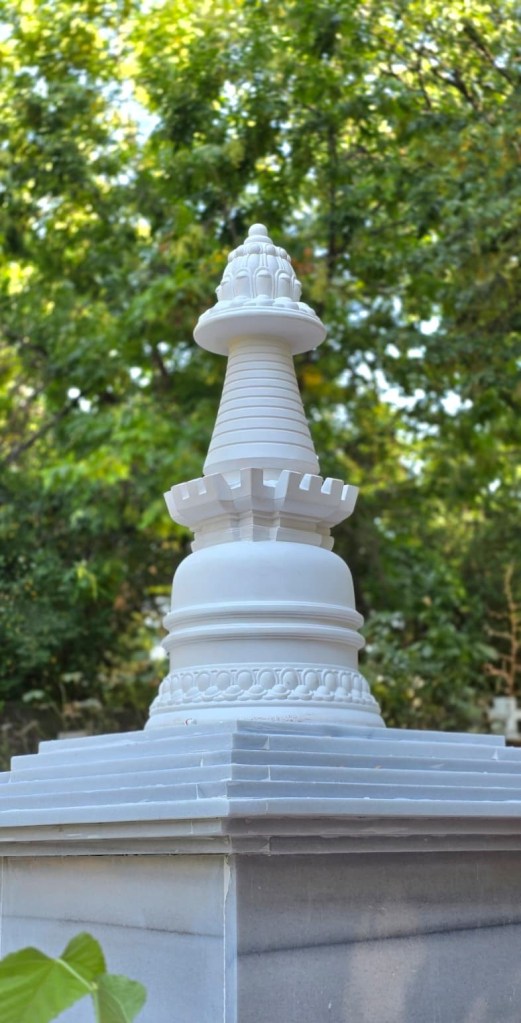
Regular readers of this site will remember where we started: a small Stupa inside a lantern, on the corner of my Father’s grave, and a dream that it might one day become something bigger. We asked for permission, and two plots of land were concessioned to us for 200 years. We asked Nalanda Monastery in France for a Kadampa stupa, and Ven. Tenzin Gendun began polishing and painting it under his own patient hands. We gathered mantras, herbs, gems, oils, precious metals, and a Romanian flag, and sent them across a continent to be placed inside it. We built a Throne to hold it, filled slowly, over months, with coins and crystals and soil and devotion offered by our own community.
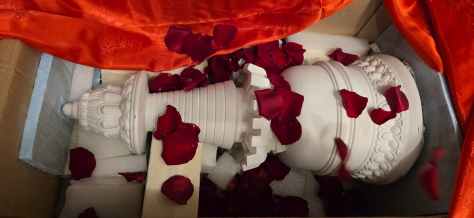
All of that; the cemetery plots, the groundbreaking ceremony, the stupa built and blessed at Nalanda, the months of gathering and preparing and consecrating everything that would eventually rest inside it; came together on a single, extraordinary day. Rejoice.
August 18, 2026
It started early. Our colleagues, Cosmin Yeshe and Ven. Josho Adrian helped Ven. Tenzin Gendun and myself transport everything needed to the site; roughly 100 kg of materials in total. Once there, with the invaluable help of Mihaela and Mircea, the work began.
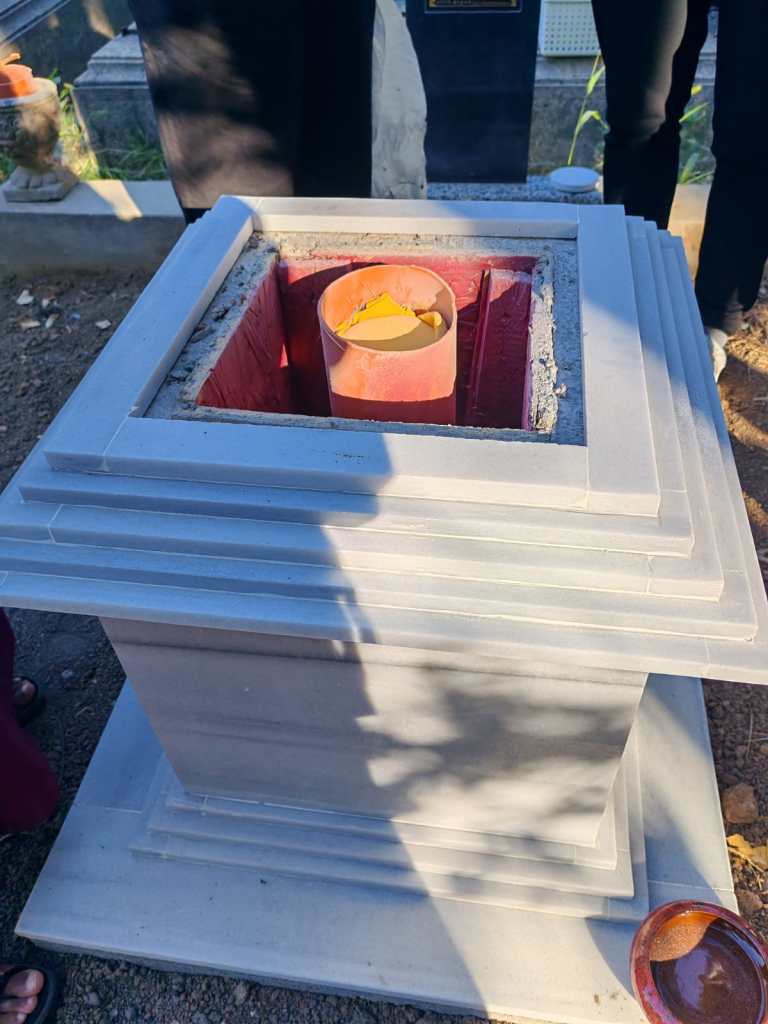
The Throne was filled, its contents following, in every detail, the instructions left by our beloved Lama Zopa Rinpoche; the same instructions we had studied together, ingredient by ingredient, in the months before.
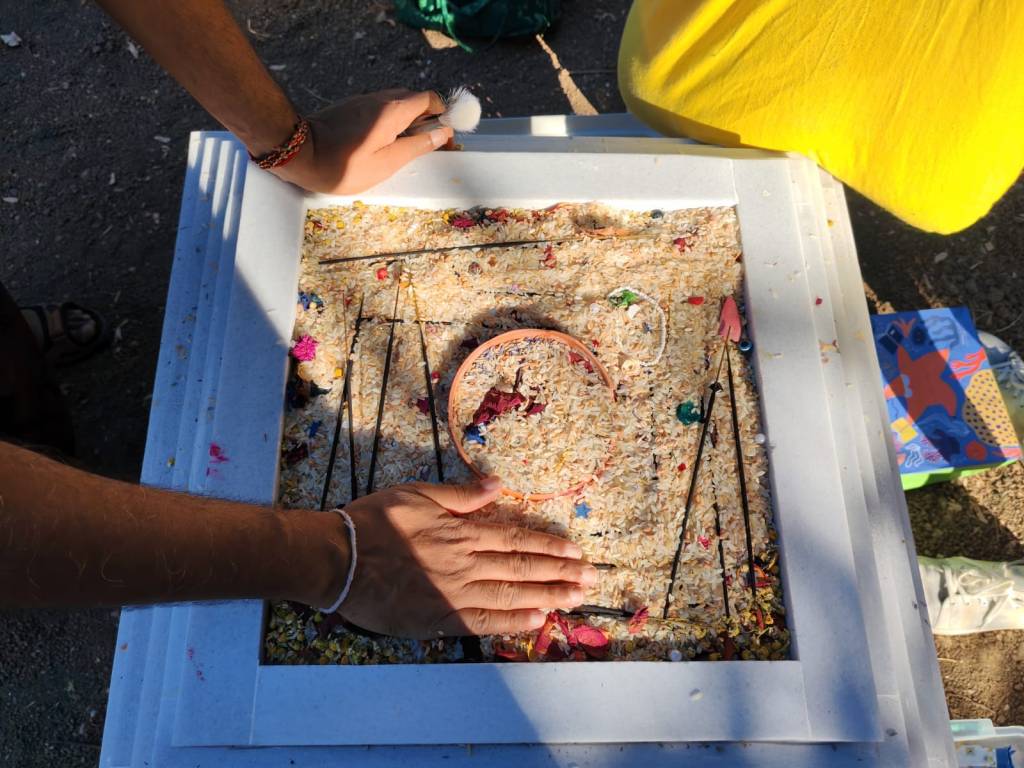
The central section was cemented, sealing in place the Naga Vase and the Earth Vase; the substances that connect the stupa to the land itself and to the local earth spirits, honoured since the groundbreaking ceremony months earlier.
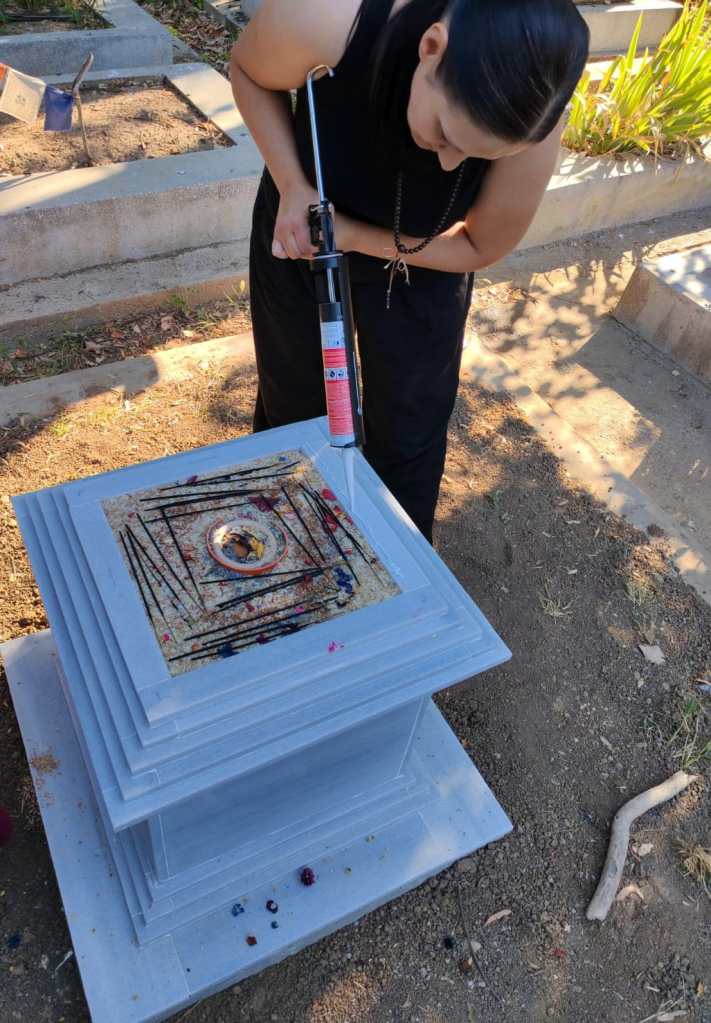
Then came the moment the whole project had been building toward: the Stupa was placed on its white marble throne, secured with cement and silicone. It was the meeting point of everything built up until then; the marble base constructed here in Bucharest, and the painted, consecrated Stupa body shipped from Nalanda.
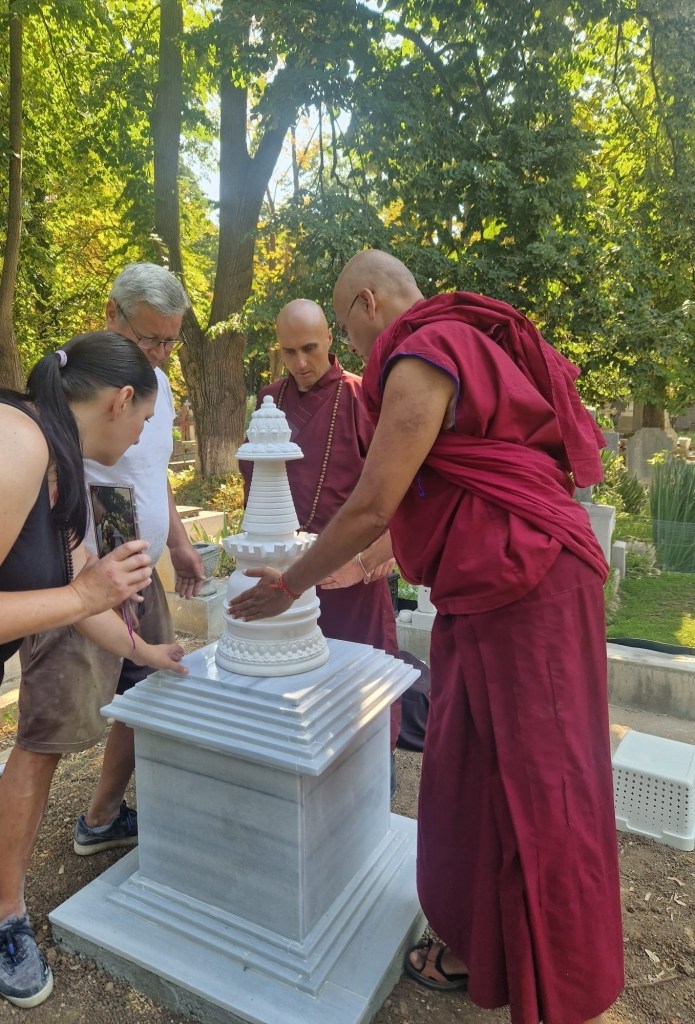
And then, as if in answer, a rainbow appeared and wrapped around the group in its colours. Everyone breathed deeply, in gratitude.
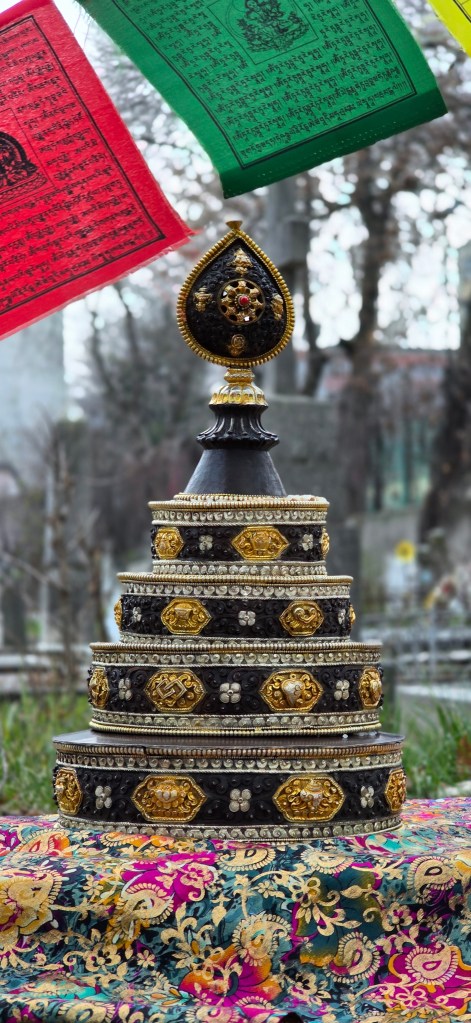
Offerings and a Mandala were presented, with tears of joy.
Ven. Tenzin Gendun officiated the Gektor and Rabné ceremonies; the final consecration rites that transform a physical structure into a living holy object, preceded, as tradition holds, by an offering that clears the site of interference before the invitation to the buddhas of the ten directions is made. Extended dedications were recited for all beings. Ven. Josho Adrian recited hymns to Amitabha, drawn from the Great Sutra of Amitayus Buddha, followed by the Heart Sutra.
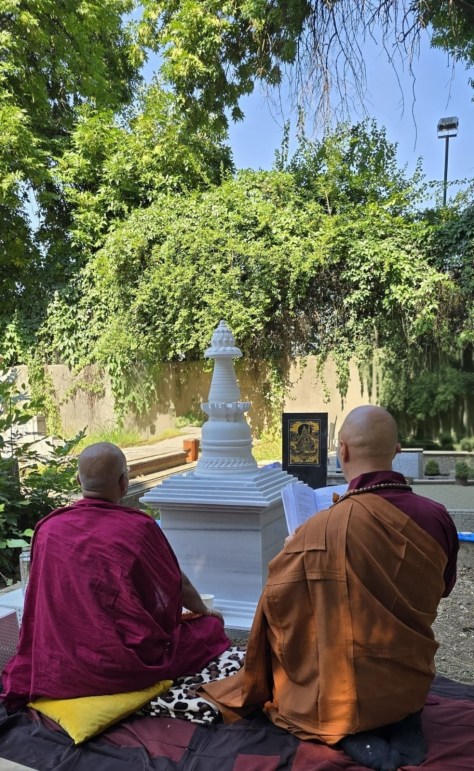
The group then sat together in silence and meditation, dedicating the merit of the day to everyone carried in their hearts, and beyond that, to all sentient beings.
What We Built, and What It Means
It seems right, now that the Stupa is standing, to say something about what it actually is; not just as an object we built, but as something the tradition has thought about, with extraordinary care, for a very long time.
Among the three kayas; the truth body, the enjoyment body, and the emanation body; a Stupa is traditionally understood to represent the dharmakaya. Where a statue represents the Buddha’s holy body and a text represents his holy speech, the Stupa represents his holy mind. Early commentarial sources describe the ground on which a Stupa is built as itself an expression of the dharmakaya, and encourage practitioners to see the stupa as a mirror of great compassion, of the branches of enlightenment, of the powers and forces of the path. This is why a Stupa is never simply an architectural form. It is a body built to hold the entire path to awakening, so that anyone who approaches it, whether or not they understand a word of what it represents, comes into contact with something of that mind.
That idea, that every part of a Stupa is doctrine translated into form, runs through the tradition’s classical descriptions. Atisha’s consecration instructions read the stupa the way a text is read: the foundation as the ground of reality itself, the terrace steps as the stages of the path, the vase as the branches of enlightenment, the parasol as the protection of compassion. Later commentators extend the same reading in even finer detail.
The base that “holds the earth” stands for the ten virtuous actions of body, speech, and mind. The three steps above it stand for the three refuges: Buddha, Dharma, Sangha. The lion throne stands for the four fearlessnesses. The treasure vase stands for the eight noble riches. The lotuses stand for the six perfections: generosity, ethics, patience, joyful effort, concentration, wisdom. The thirteen rings above the vase stand for the ten bodhisattva grounds and the path that leads through them, and the sun, moon, and jewel at the very summit stand for the elimination of suffering, the radiating of compassion, and the fulfilment of every wish. Nothing on a finished stupa is decorative. Every proportion is a teaching, built so that the structure itself becomes an object of study as much as an object of devotion; and every proportion of ours, from the Throne we filled in Bucharest to the vase now sitting above it, follows this same inheritance.
Physically, a Stupa rises in stages, and each stage carries forward this same logic of the path made solid. The foundation is laid first, sunk into ground that has itself been prepared with care; in our own case, this meant the quiet, respectful work of tending land that had not been disturbed without honour, before a single stone of the Throne was set. Reinforcement is set from the very base up through the walls, because everything that follows – the throne, the vase, the thirteen wheels -depends on what is buried first.
The Throne is built next, and it is built to be filled. Some Throne sections are cast as a sealed block, with all their contents placed and blessed before the walls close over them; more often, an opening is left so that the ingredients can be packed in by hand once everything has been gathered and consecrated, then sealed from within. This was our own path: a Throne left open through the summer, so that our Sangha, our family, and our community could bring their coins, their crystals, their pinches of soil, before it was finally closed on August 18th.
Above the Throne rises the bumpa, the vase; the rounded body that gives the stupa its most recognisable silhouette, and, symbolically, the seat of the seven branches of awakening. It is the most demanding stage to build, requiring exact proportion on every side. Between the top of the throne and the base of the vase, a further cavity is left for the life tree and for more of the ingredients that make the Stupa whole; the dimensions and detail differ slightly for each of the eight traditional stupa types, ours being Kadampa, but the principle is constant: nothing above the foundation is left hollow, and nothing is closed until it has been properly filled.
The ingredients themselves are gathered slowly and by hand, and every category has a place. At the very heart go the mantras: the four dharmakaya relic mantras first, followed by mantras of all four classes of tantra, mantras of the great lineage teachers, sutra mantras, and the verses of auspiciousness, each rolled around a stick of incense, wrapped in yellow or saffron-coloured cloth, and marked so that it goes in facing the right way.
Around and above them go volumes of Dharma text, gems, precious metals, seeds, medicinal herbs, water and earth from places held to be holy, and, in Lama Zopa Rinpoche’s own phrase, “any kind of precious objects, even tiny.” Nothing offered with sincerity is considered too small to include; this is exactly the spirit in which we asked our own community, through June and July, to bring whatever they could.
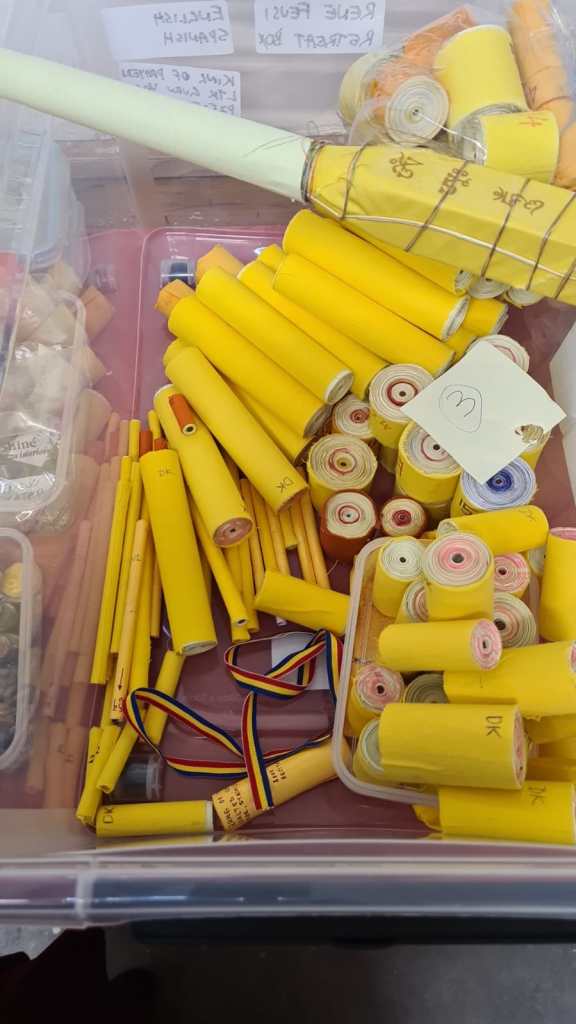
Before any of this can be placed inside a Stupa, it has to be blessed; this is the purpose of the ritual known as Sung Drub, a dedicated practice for consecrating the statues, mantras, and substances before they ever enter the structure. Only once the ingredients have been blessed, and the inside of the stupa cleaned and sealed against insects, does the actual filling take place, level by level, each layer of mantras and substances packed tightly and separated by cloth so that nothing shifts once the Stupa is closed. This is what happened, in full, on the morning of August 18th, when the Throne was finally filled following Rinpoche’s instructions to the letter.
The final stage is Rab Nä, the consecration proper; the ritual that transforms a filled, physical structure into what the tradition calls a living holy object; the ceremony is preceded by a Gektor offering that clears the site of interference before the invitation is made, and closes with recitations and verses of auspiciousness that seal the blessing in place; this is precisely the sequence Ven. Tenzin Gendun performed for us, ending in the silence and meditation that closed our day.
Why It Was Worth Every Hour
The teachings are unusually direct about what all of this is for. Holy objects, Lama Zopa Rinpoche explains, bless the land and plant the seed of enlightenment in anyone who encounters them; merely seeing a Stupa is said to purify the mind, and even dreaming of one, or simply remembering one that has been seen, is described as planting a seed of lasting benefit. The purification is not limited to people. Insects, dust, even the wind that has touched the Stupa and then touches a passing being, are said to carry a measure of that same blessing outward. Circumambulating a Stupa is recommended for long life, for healing, and for clearing the kind of obstacles that show up in ordinary life as illness, difficulty at work, or a stalled search for direction; the practice is simply to walk, to recite, and to visualise light radiating from the structure and settling into one’s own body.
Rinpoche returns often to the same conclusion: a Stupa works without needing anyone to believe in it. It calms the mind of whoever comes near, offers a place to grieve or to hope, and quietly settles a place down; a country with a Stupa is, in this sense, described as fortunate regardless of who visits it or why. And because a Stupa’s benefit is said to be inconceivable rather than limited, every person who helped build ours, fund it, or simply carry a stone to its Throne shares directly in that same, ongoing benefit; long after our own hands are gone, the object itself will continue the work.
Bucharest now has a fully consecrated Kadampa stupa, standing in open air, in our cemetery-garden, accessible freely to anyone who walks past; for the next 200 years, and beyond.
The small Stupa in the lantern is still there too, on the corner of my Father’s grave; tiny, faithful, lit by its own light. It was the seed. This is what grew from it.
May whatever merit arises from this day be dedicated to the swift return of our precious Teacher, to the long lives of all our Teachers, and to the happiness of every being without exception.
In faith, the constructor offers this Stupa to Padmasambhava Guru Rinpoche, for the benefit of all beings.
— Veronica Sonam Drölma
Teachings on the meaning, elements, and benefits of stupas drawn from Lama Zopa Rinpoche, Benefits and Practices Related to Statues and Stupas, Parts 1–3 (FPMT Education Services).
The builder of this Stupa, unworthy of the grace that has been bestowed upon her, would like to offer a personal word of gratitude:
- to the pecious advisors from FPMT, that granted us their trust – especially to Francois Lecointre, Steff Hill and the entire staff an residents of Nalanda Monastery in France;
- to our precious Teachers, Geshe Jampa Gelek, Geshe Thubten Sherab, Venerable Tenzin Gendun, and to Thubten Sherab Sherpa;
- to the colleagues, Sangha brothers and sisters of the other two FPMT centers in Romania, and their coordinators – precious and beautiful Dharma Friends – Alexandra Grigorescu and Marius Micu;
- to the precious Dharma colleague, Venerable Josho Adrian, lineage holder of Jodo Shinshu Buddhism, Amidaji branch – in Romania;
- to my best friends, Dharma Brothers Silviu Gherman, Christian Anton and Tenzin Julian;
- to all the people that contributed with ingredients for the Throne and Stupa;
- to the cemetery custodians who were incredibly kind and generous towards us;
- to K.R.: my kind, precious, beloved Teacher, who laid the foundation of any good qualities I may have – to you I bow.
This Mandala is for all of you, with prostrations and deepest gratitude.
Sarva mangalam!
 gardenofmaitreya.com