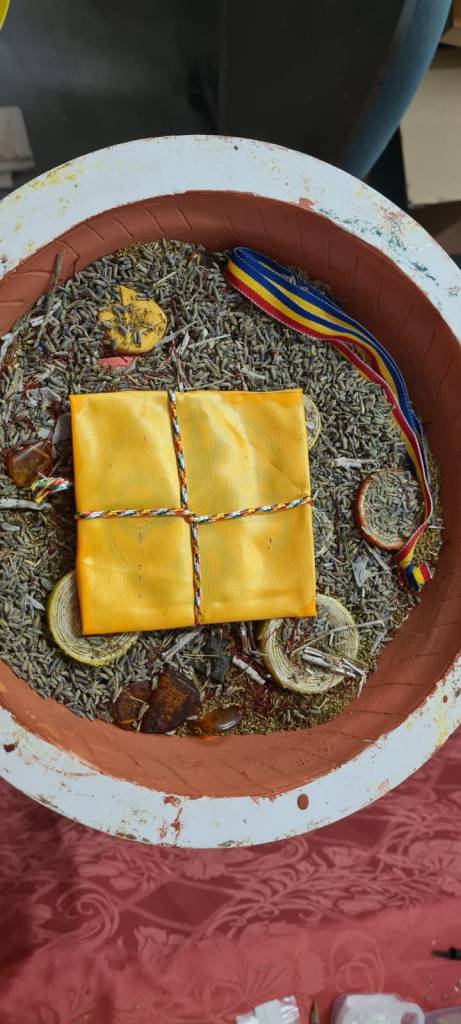
There is a Stupa being polished at this very moment at Nalanda Monastery in France, under the blessed hands of our Teacher, Venerable Tenzin Gendun – monk, painter, quiet craftsman of holy objects. The Stupa does not have a name yet. It is still becoming. But yesterday it received what makes a stupa a stupa, what turns a beautiful form into a living relic of the Buddha’s enlightenment: its Heart.
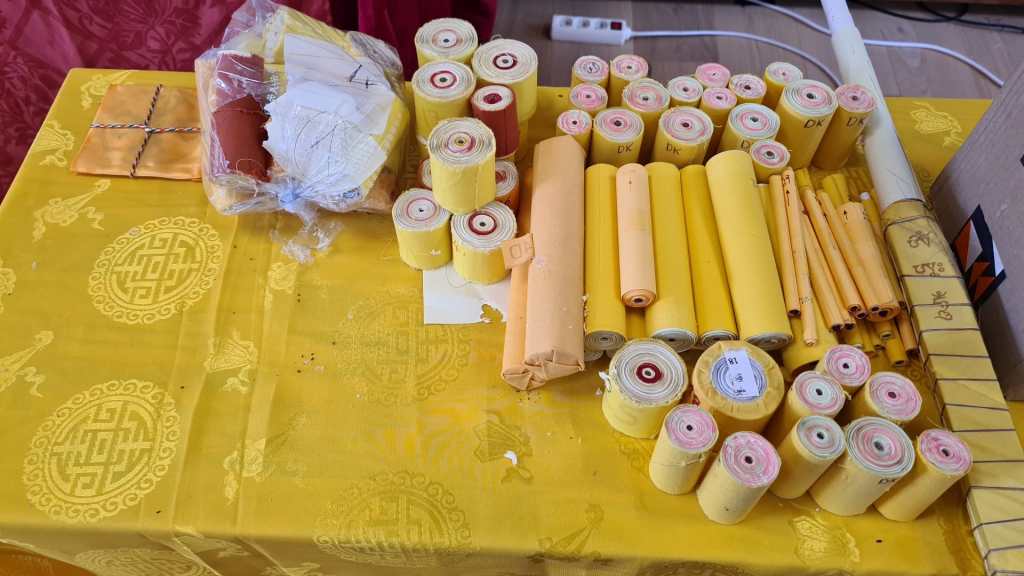
Inside it, with prayers and tears and that particular kind of joy that does not need words, the mantras were placed.
The Four Dharmakaya Relic Mantras have the central place.
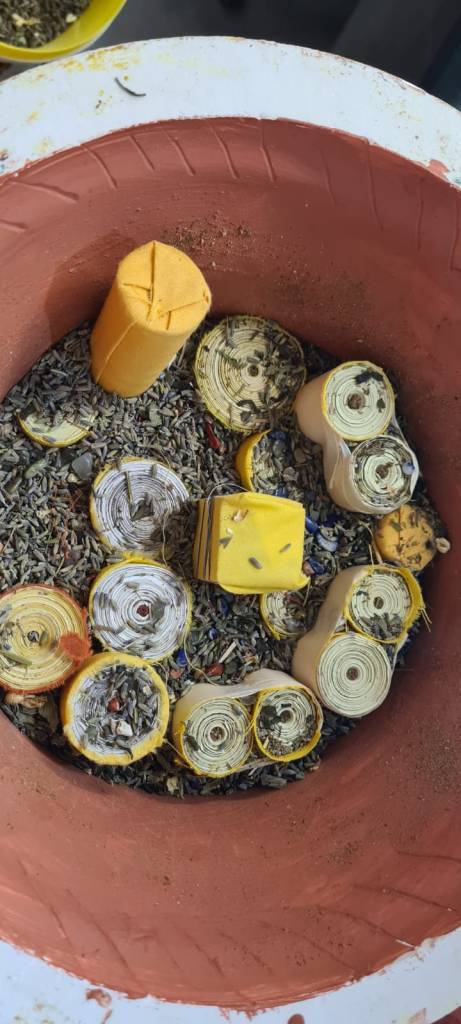
And around them, like Offerings encircling the Centre of a mandala, Venerable Gendun placed everything precious we could gather and send to him: rolls of mantra, lavender for fragrance and calm, camomille and mint from the earth, gems and precious stones (amethyst, agate, and others), sand from sacred mandalas, gems that had been offered upon mandalas in previous practices, scented oils, fragments of precious metals (gold, silver), and the Romanian flag… because this Stupa is going Home to Romania.
What Are the Four Dharmakaya Relic Mantras?
To understand what just happened inside this small wooden vessel of awakening, one must understand what Lama Zopa Rinpoche found, with his own hands, in the Kangyur.
Rinpoche has told the story many times of how he discovered them. He had asked a Tibetan geshe at Deer Park whether these mantras were perhaps Nyingma, because the text he knew, The White Crystal Mirror, mentioned their names but did not contain the mantras themselves. Geshe Dönyo mentioned that a great Sera Je lama had written two volumes referencing these mantras. Rinpoche then traced them all the way back to the Kangyur, the word of the Buddha himself. As Rinpoche says in his own words:
“Once I read about the mantras, I was completely amazed by the skies of benefit these Four Dharmakaya Relic Mantras have. Then, when I went to Kopan, I suggested they build the eight types of stupas. This is how all the stupa building in FPMT started.”
These four mantras are not ordinary mantras. They are not “supportive” ingredients. They are, in Rinpoche’s words, the highest relic of the Buddha; relics of the Dharmakaya itself. The robes, the bone fragments, the tooth relics that we venerate around the world… these, Rinpoche reminds us, are secondary relics. The Four Dharmakaya Relic Mantras are the Primary relic. They are what makes a stupa a Buddha.
Rinpoche puts it with that characteristic directness of his:
“The four dharmakaya relic mantras are the main mantras that give power to holy objects. They are what make holy objects most powerful and beneficial, and make it easy for sentient beings to purify negative karma and collect extensive merit. It is like having thousands of atomic bombs to purify the negative karma.”
Thousands of atomic bombs of purification. That is what is now sitting, rolled in yellow, in the heart of our little stupa.
The four are these:
1. Stainless Pinnacle Deity Mantra (Tsugtor Drime)
As taught by the Buddha in the Kangyur, even one prostration, one circumambulation, or one offering made to a holy object containing this mantra purifies completely the five uninterrupted negative karmas (killing one’s father, killing one’s mother, killing an arhat, causing blood to flow from a buddha, and causing a schism in the Sangha). One is completely liberated from the hell, hungry ghost, and animal realms, and from the evil-gone realm of the yama world. One will have a long life. When leaving the body, one will have the fortune to go to a pure land. One will never again be stained by the smell of the womb. All one’s wishes will be completely and exactly fulfilled.
If this mantra is inside a stupa, you will never be reborn in the lower realms and will have a pure life until you achieve enlightenment.
2. Secret Relic Mantra (Sangwa Rigsel)
The Buddha taught Vajrapani that wherever this mantra is, all the Buddhas of the ten directions abide there. Printing the Secret Relic Mantra even once collects the same merit as making offerings to 100,000 x 10 million x 100 billion buddhas. The merit equals having offered to as many buddhas as there are seeds in ninety-nine sesame pods, and one is then continually guided by all of them. One never turns back from enlightenment; the direction of one’s life becomes irreversible.
3. Zung of the Completely Pure Stainless Light (Özer Drime)
This is the mantra of which I have personally, by Rinpoche’s instruction, recited 8,000 repetitions before doing anything in the Project.
The benefits explained in the Kangyur are almost beyond what the mind can hold. If even a bell is offered to a stupa containing this mantra, every sentient being who hears that bell is purified of the five uninterrupted negative karmas. The rain that falls on such a stupa, the dust that touches it, the wind that brushes against it, even the shadow it casts upon the ground… all of these purify the heavy negative karma of any insect, any human, any being they then touch.
In the Buddha’s own words in the Kangyur:
“If this mantra is put inside a stupa then any being, including evil transmigratory beings, who sees the stupa, hears of the stupa, touches the stupa, or who is touched by dust or wind that comes from this stupa, will be free from all negative karmas. They will be born in the realms of happy transmigratory beings and they won’t be reborn in the lower realms.”
This is what was placed inside it yesterday. This is what 8,000 recitations were for.
4. The 100,000 Ornaments of Enlightenment (Jangchub Gyänbum)
By putting even one mantra of the Ornament of Enlightenment inside a stupa, the merit is the same as having built 100,000 stupas; whether the stupa is gigantic like Bodhgaya or tiny like the size of a finger. One collects the merit of having made offerings to all the Buddhas, all the Dharma, all the Sangha. Why? Because, as Rinpoche explains, when you make offering to a stupa containing this mantra, you are not only making offering to a stupa. You are making offering to all the Three Rare Sublime Ones existing throughout the ten directions, in every universe.
The Buddha told Ananda directly: “I explained this sutra for those beings who have very little merit and no devotion, for those who are overcome by doubt and cannot believe in the Dharma.” Rinpoche then adds, with that gentleness only he can carry: “That means Buddha explained this mantra for us.”
For us. Not for the ancient saints. For us.
What This Means for the Garden of Maitreya
After the Stupa is fully polished and painted by Ven. Tenzin Gendun, it will travel to Bucharest. It will be placed in the cemetery-garden where we gather for practice, on the small plot of land that has been concessioned to us for 200 years.
Two hundred years. Think about what that means now.
For two centuries, (and I will make sure way after that, too) this stupa will stand on Romanian soil. Every rain that falls on her, every snow, every wind that comes off the Carpathians and brushes her form, every shadow she casts on the grass and on the graves of those who came before us, every bird that lands on her, every insect that crawls past her base, every passer-by who simply sees her, even those who have no idea what she is… all of them will be touched by the activity of the Buddhas of the ten directions.
This is not poetry. This is the Buddha’s word in the Kangyur, as quoted by Lama Zopa Rinpoche.
And as Rinpoche says, holy objects such as these “liberate sentient beings continuously, twenty-four hours a day, every day.”
May every being who sees this Stupa, hears of it, dreams of it, walks past iter, or simply shares the air around it, be freed from suffering and brought, swiftly and joyfully, to full enlightenment.
–Veronica Sonam Drölma