
Who is Padmasambhava?
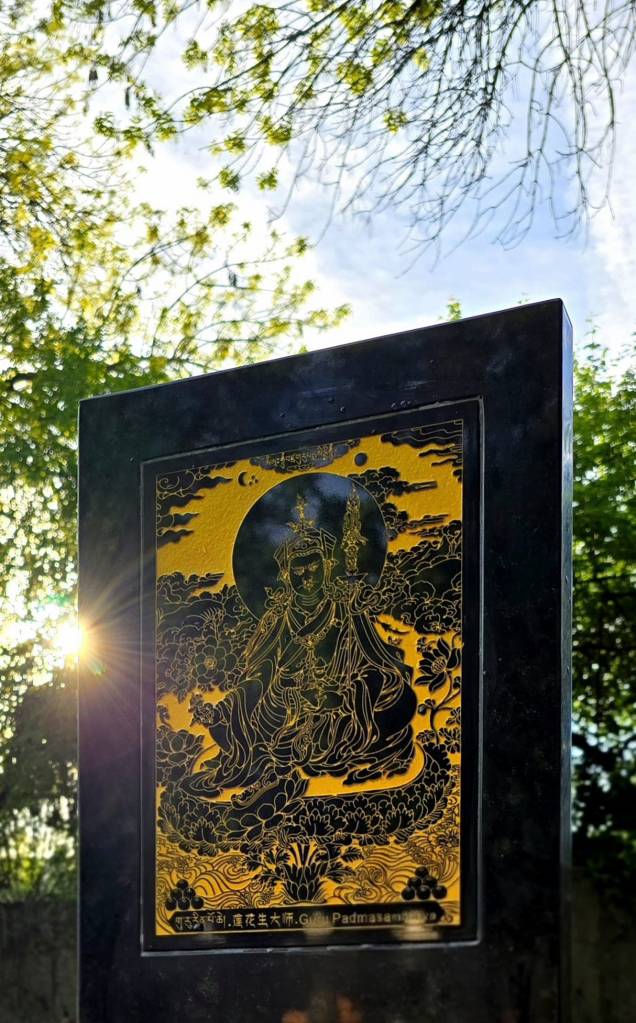
Padmasambhava is one of the most beloved figures in Tibetan Buddhism. His Sanskrit name means “Lotus-Born,” because tradition says he appeared as a child inside a lotus flower on a lake in the land of Oḍḍiyāna. Tibetans usually call him Guru Rinpoche, which means “Precious Teacher.”
He was an Indian tantric master who came to Tibet in the 8th century at the invitation of King Trisong Detsen. Working alongside the scholar-abbot Śāntarakṣita, he helped establish Samye, the first Buddhist monastery in Tibet. The stories say he overcame the forces that were obstructing the spread of the Dharma there, and he gave many teachings and empowerments to his disciples. He also concealed teachings, called terma, to be rediscovered in later generations. For the Nyingma school he is honored as a “second Buddha,” but practitioners of every Tibetan tradition revere him.
What is “Day 10”?
Tibetan Buddhism follows a lunar calendar, so each month begins with the new moon. The tenth day of every lunar month (Tibetan tsechu, “tenth day”) is dedicated to Guru Rinpoche. This means the date moves around in the Western calendar, falling roughly ten days after each new moon, while the moon is waxing.
The tenth day is one of several special days in each month. For example, the 15th is the full moon and the 25th is Ḍākinī Day. Tradition holds that on these days the results of virtuous actions, both positive and negative, are greatly multiplied. That is why many people choose these days for prayer, offerings and practice.
Why the tenth day?
Guru Rinpoche promised his disciples that on the tenth day of each month he would come before anyone who calls on him with devotion. Because of this promise, followers of his lineages give special importance to this day and treat it as a time when his blessings are especially close.
“If he comes, why can’t we see him?”
This is a natural question for beginners, and the passage you shared addresses it directly. In a book borrowed to me by a friend, I read this explanation from Namkhai Norbu Rinpoche: Guru Rinpoche said his rainbow body would be present at that time, and that his manifestation would appear together with the rays of the sun at sunrise and sunset. We sing the prayers and visualize him, but most of us don’t see anything.
The reason, he says, is not that Guru Rinpoche is absent. The limit lies in our capacity to perceive. He uses the example of water. When we see water, we see something to drink, to wash with or to swim in, something solid we can touch. This way of seeing is shaped by our karma. We don’t see the pure nature, the essence, of the water element. Guru Rinpoche manifests from that essence of the elements, so with our ordinary karmic vision we cannot perceive him. A practitioner who has developed clarity through practice may be able to, and that is considered a good sign.
He also tells a lovely story to show that this is possible. When his son Yeshi was three years old, the family lived in Pozzuoli, near Naples. One morning Namkhai Norbu was doing his practice in the sunlight when he noticed that his little son had come in and was sitting beside him, also gazing at the sun’s rays. When asked what he was seeing, the child said he saw “a little half of Padmasambhava.” Later, when given paper and colors, he drew a small sphere of light (a thigle) with part of Guru Rinpoche’s figure inside it. His father kept the drawing and wrote the date on it.
For a beginner, the important point isn’t to expect visions. It is to understand that Guru Rinpoche’s presence doesn’t depend on whether we can see him. What we bring is devotion and a sincere connection, and our capacity grows through practice.
What do practitioners do on Day 10?
The practices vary by lineage and by what a person has received, but common ones include:
🙏 Reciting the Seven-Line Prayer (Seven-Line Invocation), the best-known prayer for calling Guru Rinpoche;
🙏 Reciting his mantra, Oṃ Āḥ Hūṃ Vajra Guru Padma Siddhi Hūṃ;
making offerings such as butter lamps, candles, flowers or incense;
🙏 For practitioners who have the necessary empowerments, doing a Guru Rinpoche sādhana or a tsok (gaṇacakra), a ritual feast offering, which is very commonly held on the tenth day.
Anyone can join in with the simplest form: remembering Guru Rinpoche with devotion, reciting the prayer or the mantra, and dedicating the merit for the benefit of all beings.
Veronica Sonam Drölma

